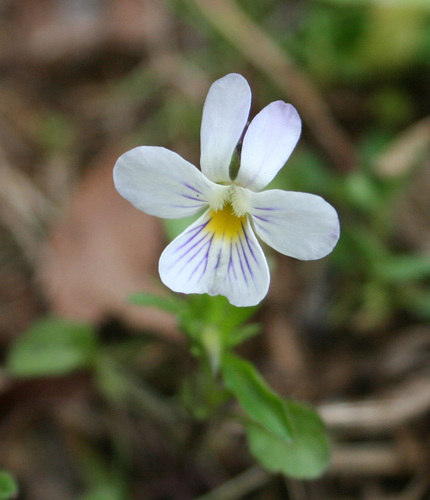


American Field Pansy
viola rafinesquei
The American Field Pansy is a charming, delicate native North American wildflower that announces the arrival of spring with its carpet of miniature blooms. Often overlooked due to its diminutive size, this annual plant plays a vital role in early-season ecosystems by providing a crucial food source for early-emerging native bees and butterflies. Despite its fragile appearance, it is remarkably resilient, popping up in lawns, roadsides, and agricultural fields before other plants have fully woken up from winter. Its complex reproductive strategy, which includes both showy, insect-pollinated flowers and hidden, self-pollinating ones, ensures its survival across diverse and disturbed landscapes. This little violet is a delightful discovery for any nature enthusiast looking closely at the ground in early spring.
Habitat: Found in open, sunny disturbed areas, meadows, lawns, pastures, and along roadsides, often in sandy or nutrient-poor soils.
This diminutive annual herb stands 7 to 30 centimeters tall, featuring simple, smooth-edged to lightly lobed leaves and distinctive leaf-like stipules at the stem joints. Its flowers are small, about 1 to 1.5 centimeters wide, showcasing five petals that range from pale blue-violet or lavender to creamy white. The lower petals feature yellow bases with striking, fine purple veins that serve as nectar guides for pollinating insects.
Category
PlantsRarity
Common
Danger
1/5 · Very low
Snaps
2
It is one of the very first native wildflowers to bloom in North America each year, often showing flowers as early as late February.
Its seeds are actively harvested by ants who eat the nutritious oily coating and discard the seed unharmed in their nutrient-rich waste piles, perfectly planting them.
The plant's common name, 'pansy', derives from the French word 'pensée', which means 'thought' or 'remembrance'.
Produces inconspicuous, closed, self-pollinating flowers near the ground that guarantee seed production even without pollinators.
Seeds have nutrient-rich appendages called elaiosomes that entice ants to carry and plant them underground.
When mature, the seed capsules split open and forcefully squeeze the seeds out, launching them up to several feet away.
Like most plants, it is a photoautotroph that generates its own organic energy using sunlight, water, carbon dioxide, and mineral nutrients from the soil.

Euptoieta claudia
The caterpillars of this butterfly use Viola species, including the American Field Pansy, as their primary larval host plant.
Andrena carlini
An early spring pollinator that visits the flowers for nectar and pollen, aiding in genetic cross-pollination.
.JPG&width=800)
Sylvilagus floridanus
This common mammal grazes on the leaves and stems of the plant during the spring when other greenery is scarce.
No trait badges are assigned for this object yet.
No aliases listed yet.
Collections for this object will appear here as more themes are added.
Danger
1/5 · Very low
No special safety notes yet.
The easiest way to identify American Field Pansy is to use the Snappit nature identifier app.
7-30 cm
1 years
Like most plants, it is a photoautotroph that generates its own organic energy using sunlight, water, carbon dioxide, and mineral nutrients from the soil.
Found in open, sunny disturbed areas, meadows, lawns, pastures, and along roadsides, often in sandy or nutrient-poor soils.
Zoom in to split clusters and explore where this object has been snapped.

Alabama, US
You might spot Anole, Bee, and Bristle Thistle.
View guide →

Alabama, US
You might spot Anole, Bee, and Bristle Thistle.
View guide →

Alabama, US
You might spot Cave Salamander and Pink Lady's Slipper.
View guide →

Illinois, US
You might spot Olympia Marble and American Field Pansy.
View guide →

Georgia, US
You might spot Tiny Bluet, Mountain Laurel, and Eastern Box Turtle.
View guide →
Take the discovery with you
Snap it with Snappit to identify it, learn what makes it special, and add the discovery to your collection.











.jpg&width=800)



_001.jpg&width=800)




