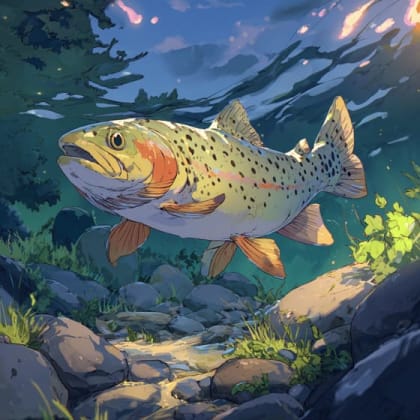
American Gizzard Shad
dorosoma cepedianum
The American Gizzard Shad is a shiny fish that loves to swim in schools. It has a special gizzard that helps it eat tiny plants and animals in the water!
Habitat: Lakes, rivers, and reservoirs across North America
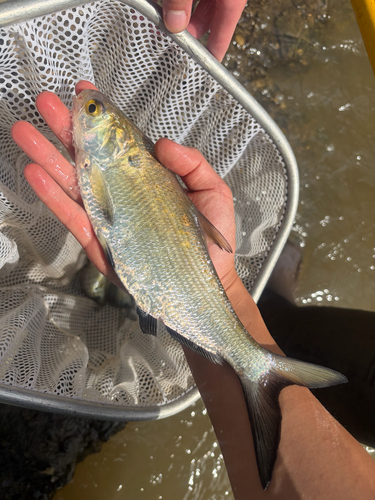
The American Gizzard Shad has a distinctive deep, silvery body, often with a slightly darker blue-green back. Its most notable feature is a very long, whip-like ray extending from the dorsal fin. They also possess a small head and a blunt snout.
Category
FishRarity
Common
Danger
0/5 · No known danger
Snaps
3
Their long dorsal fin ray can be longer than their whole head!
They are named for their gizzard-like stomach, just like a chicken!
They play a super important role, turning tiny particles into food for bigger fish!
Thousands of Gizzard Shad often swim together in huge, shimmering schools!
American Gizzard Shad has a muscular gizzard stomach, similar to birds, that helps them grind tough plant material.
American Gizzard Shad can filter-feed using special gill rakers, allowing them to eat microscopic plankton from water.
American Gizzard Shad can survive in murkier, less oxygenated, and even slightly polluted waters that many other fish avoid.
They are filter-feeders, scooping up tiny plants and decaying bits from the water.
Age differences: Younger shad primarily eat zooplankton, while adults shift to consuming more phytoplankton and detritus.
Social animals live in organized groups, cooperating for survival benefits such as foraging, defense, and raising offspring.
Filter feeders obtain nutrients by straining suspended food particles and small organisms from water.
This trait identifies organisms whose diet consists entirely or primarily of animal tissue.
Aquatic habitats encompass environments where organisms live predominantly in water, including oceans, rivers, lakes, and wetlands.
Danger
0/5 · No known danger
No special safety notes yet.
The easiest way to identify American Gizzard Shad is to use the Snappit nature identifier app.
20-40 cm
0.2-1 kg
5-10 years
They are filter-feeders, scooping up tiny plants and decaying bits from the water.
20 km/h
Lakes, rivers, and reservoirs across North America
Filter Feeding
Zoom in to split clusters and explore where this object has been snapped.
Jun 4, 2026
New Indianola Historic DistrictPhoto attribution
(c) Steven Wang, some rights reserved (CC BY)
License: CC BY 4.0 ↗
Image may be shown cropped inside the card frame.

West Virginia, US
You might spot Asian Lady Beetle, Eastern Box Turtle, and American Robin.
View guide →

Iowa, US
You might spot Monarch and American White Pelican.
View guide →

Ohio, US
You might spot Spotted Lanternfly and Eastern Gray Squirrel.
View guide →
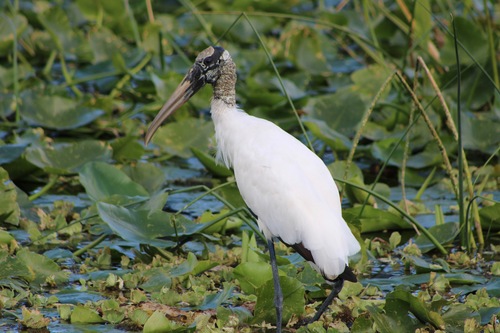
Florida, US
You might spot Wood Stork, Brown Anole, and Taro.
View guide →
Take the discovery with you
Snap it with Snappit to identify it, learn what makes it special, and add the discovery to your collection.