

Ash-Throated Flycatcher
myiarchus cinerascens
The Ash-Throated Flycatcher (Myiarchus cinerascens) is a charismatic and vocal member of the flycatcher family, recognized for its energetic aerial pursuits of insects. These medium-sized passerines are quintessential inhabitants of arid and semi-arid landscapes across western North America, where their distinctive calls often echo through open woodlands and scrublands. Their presence signifies healthy shrub and tree habitats, as they rely on existing cavities for nesting, often integrating unique materials like shed snakeskins into their nests, a peculiar behavior that fascinates naturalists. As a neotropical migrant, their annual journeys connect diverse ecosystems, making them an interesting subject for migration studies and a beloved sign of summer in their breeding grounds.
Habitat: Found in open woodlands, arid scrub, riparian areas, and oak or pinyon-juniper woodlands, often in dry, hilly country.
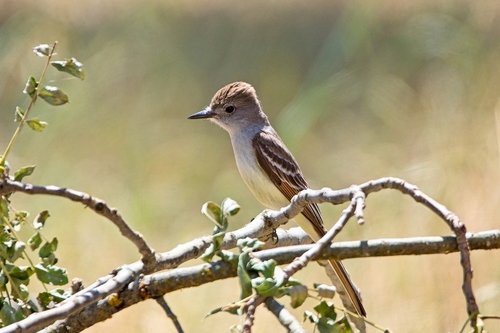
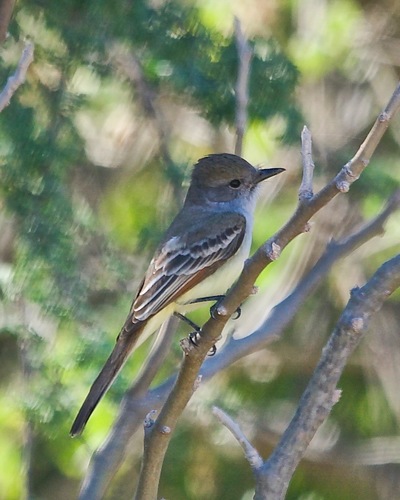
The Ash-Throated Flycatcher is a medium-sized songbird, typically measuring around 19-21 cm in length with a wingspan of 28-32 cm. Its plumage is characterized by a distinctive ash-gray throat and breast, contrasting with a pale yellow belly. The back and head are olive-brown, and it often exhibits a subtle, peaked crest. Key identification features include rusty outer tail feathers, visible both when perched and in flight, and two faint wing bars. Its bill is relatively broad and flat, typical of insectivorous birds that catch prey in mid-air.
Category
BirdsRarity
Common
Danger
1/5 · Very low
Snaps
6
Ash-Throated Flycatchers are one of the few bird species known to regularly incorporate shed snakeskins into their nests, a behavior believed to deter predators.
Their vocalizations are quite varied, including a distinctive 'ka-brick' call and a gruff 'prrrrit' that helps identify them even when hidden in foliage.
They are long-distance migrants, traveling thousands of kilometers between their breeding grounds in North America and their wintering grounds in Mexico and Central America.
Unlike many songbirds that build open-cup nests, these flycatchers are obligate cavity nesters, relying on pre-existing holes in trees or snags.
Ash-Throated Flycatchers are expert aerial hunters, making quick sallies from a perch to snatch insects directly out of the air. Their agile flight and keen eyesight allow for precision captures.
Unlike many songbirds, this species exclusively nests in tree cavities, often utilizing old woodpecker holes or natural crevices. This provides protection from predators and elements.
A unique behavior involves lining their nests with shed snakeskins, a practice thought to deter predators or parasites. This quirky habit makes their nests particularly distinctive.
The Ash-Throated Flycatcher's diet consists predominantly of insects caught on the wing, supplemented occasionally by small fruits and berries. Their foraging strategy is highly effective in their preferred arid habitats.

Melanerpes formicivorus
Often uses old holes created by this species for nesting.

Pituophis catenifer
Shed skins are collected and incorporated into the flycatcher's nest lining.

Tyrannus verticalis
Competes for aerial insect prey in overlapping foraging territories.

Buteo jamaicensis
Known predator of eggs, nestlings, and sometimes adult flycatchers.
No trait badges are assigned for this object yet.
No aliases listed yet.
Collections for this object will appear here as more themes are added.
Danger
1/5 · Very low
No special safety notes yet.
Compare the silhouette, bill shape, tail length, wing bars and markings around the eyes. The same small brown bird at your feeder can look quite different in breeding plumage, winter plumage or its first year. Bird Identifier: upload a photo and compare the visible details.
19-21 cm
28-32 cm
0.02-0.03 kg
5-8 years
35 km/h
The Ash-Throated Flycatcher's diet consists predominantly of insects caught on the wing, supplemented occasionally by small fruits and berries. Their foraging strategy is highly effective in their preferred arid habitats.
Found in open woodlands, arid scrub, riparian areas, and oak or pinyon-juniper woodlands, often in dry, hilly country.
Zoom in to split clusters and explore where this object has been snapped.
Jun 9, 2026
Sonoma Botanical GardenPhoto attribution
(c) Daveozric, some rights reserved (CC BY)
License: CC BY 4.0 ↗
Image may be shown cropped inside the card frame.

California, US
You might spot Acorn Woodpecker and Western Fence Lizard.
View guide →

Colorado, US
You might spot Common Side-Blotched Lizard and Eastern Collared Lizard.
View guide →

New Mexico, US
You might spot Vermilion Flycatcher, Turkey, and American Rubyspot.
View guide →

California, US
You might spot Western Fence Lizard, Duck, and Canada Goose.
View guide →

California, US
You might spot Mule Deer, Turkey, and Duck.
View guide →
Take the discovery with you
Snap it with Snappit to identify it, learn what makes it special, and add the discovery to your collection.