


Aurora Damsel
chromagrion conditum
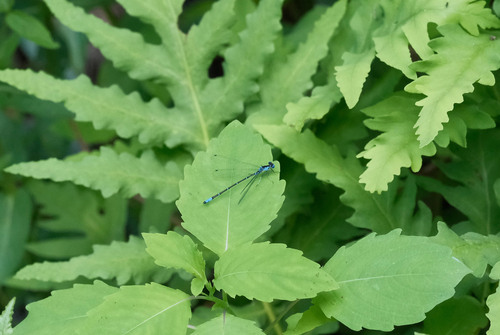
The Aurora Damsel (Chromagrion conditum) is a striking and unique damselfly native to eastern North America. As the sole member of its genus, it stands out not only taxonomically but also through its beautiful coloration and distinct posture. While most pond damselflies rest with their wings folded tightly over their backs, the Aurora Damsel frequently perches with its wings held partially open at a forty-five-degree angle. They are typically found near clean, shaded wetlands, slow-moving streams, and spring-fed seeps, where they play a vital role in controlling small insect populations.
Habitat: Found near spring-fed streams, shaded seeps, fens, and slow-moving boggy channels in forested areas.
The Aurora Damsel is a medium-sized damselfly measuring between 3 and 4 centimeters in length. It is easily recognized by its vibrant color pattern, featuring bright, glowing yellow-orange sides on its thorax that contrast with a black and bright blue top. The male's abdomen is mostly black with a conspicuous bright blue tip on segments eight and nine. Its wings are clear and slender, and unlike other pond damsels, they are often held half-open when at rest.
Category
InsectsRarity
Common
Danger
1/5 · Very low
Snaps
4
It is the only species in the genus Chromagrion, making it a taxonomically unique member of the pond damselfly family.
The common name 'Aurora' refers to the bright, sunrise-like yellow coloration on the sides of its thorax.
While most pond damselflies hold their wings closed when resting, the Aurora Damsel holds them half-open, mimicking spreadwing damselflies.
Unlike most members of its family who fold their wings completely, this species rests with its wings held partially open, aiding in thermoregulation and rapid takeoff.
Equipped with large, spherical compound eyes, it can detect the slightest movement of prey or predators in almost any direction.
In its larval nymph stage, it utilizes three caudal gills at the tip of its abdomen to extract oxygen directly from water.
Both the aquatic nymphs and aerial adults are opportunistic predators, feeding heavily on small insects and other invertebrates.
Age differences: Nymphs hunt underwater for aquatic larvae and tiny crustaceans, while adults hunt in the air for flying insects.
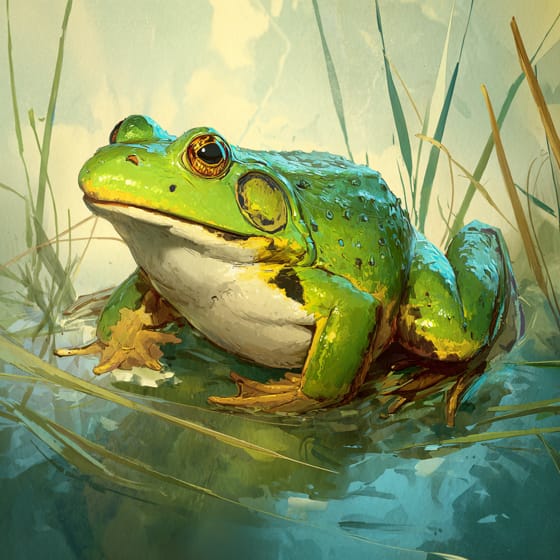
Lithobates clamitans
Larval and adult Aurora Damsels are common prey for frogs residing in the same wetland habitats.
Chironomus plumosus
Adult Aurora Damsels actively catch and consume midges in flight along stream banks.

Sayornis phoebe
This flycatcher preys on adult damselflies, including the Aurora Damsel, near stream corridors.
No trait badges are assigned for this object yet.
No aliases listed yet.
Collections for this object will appear here as more themes are added.
Danger
1/5 · Very low
No special safety notes yet.
The easiest way to identify Aurora Damsel is to use the Snappit nature identifier app.
3+ cm
4+ cm
0.00005+ kg
1+ years
15 km/h
Both the aquatic nymphs and aerial adults are opportunistic predators, feeding heavily on small insects and other invertebrates.
Found near spring-fed streams, shaded seeps, fens, and slow-moving boggy channels in forested areas.
Zoom in to split clusters and explore where this object has been snapped.
Jun 19, 2026
Days Ferry Historic DistrictPhoto attribution
(c) Doug Suitor, some rights reserved (CC BY)
License: CC BY 4.0 ↗
Image may be shown cropped inside the card frame.

US
You might spot Pink Lady's Slipper and Canada Mayflower.
View guide →

Connecticut, US
You might spot Hay-Scented Fern, Canada Mayflower, and Wood Frog.
View guide →

Connecticut, US
You might spot Downy Woodpecker and Eastern Gray Squirrel.
View guide →

Vermont, US
You might spot Northern Cardinal, Wood Frog, and White-Breasted Nuthatch.
View guide →

Wisconsin, US
You might spot Sundial Lupine, Aurora Damsel, and Lancet Clubtail.
View guide →

Ohio, US
You might spot Dot-Tailed Whiteface and Common Whitetail.
View guide →
Take the discovery with you
Snap it with Snappit to identify it, learn what makes it special, and add the discovery to your collection.












.jpg&width=800)




