.jpg&width=800)





Barrow's Goldeneye
Bucephala islandica
Barrow's Goldeneye is a beautiful duck with shiny green and white feathers. They love to dive underwater to find tasty fish and insects to eat.
Habitat: Coastal areas
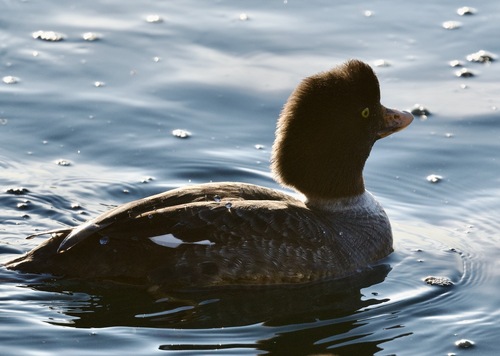
The Barrow's Goldeneye has a compact body and a large, rounded head. Males showcase an iridescent purplish-green head with a unique triangular white patch before the eye, contrasting sharply with their black and white body. Females have a brown head, grey body, and often a bright yellow bill tip, both sexes have striking golden-yellow eyes.
Category
BirdsRarity
Common
Danger
1/5 · Very low
Snaps
20
Baby goldeneyes can dive for food just one day after hatching, they're super quick learners!
Barrow's Goldeneyes don't build their own nests, instead, they often use old abandoned woodpecker holes!
These ducks are nicknamed "whistlers" because their wingbeats make a unique whistling sound!
Unlike most ducks, their ducklings jump out of tree holes from dizzying heights to reach the ground safely!
Barrow's Goldeneye can plunge to great depths underwater because of their dense bones and powerful legs that propel them.
Barrow's Goldeneye has specially adapted eyes that help them see clearly to hunt fish and invertebrates in murky water.
Barrow's Goldeneye can nest in old tree cavities, often far from water, which helps protect their eggs from ground predators.
These ducks dive deep to munch on tasty aquatic insects, crustaceans, and small fish.
Age differences: Young ducklings focus more on aquatic insects before adding fish to their diet.
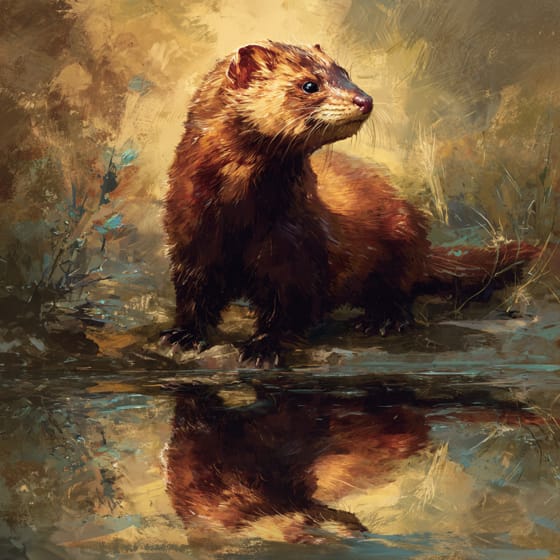
Mustela vison
Mink can prey on nests and ducklings.

Haliaeetus leucocephalus
Eagles may prey on adult goldeneyes.
Gasterosteus aculeatus
Goldeneyes feed on small fish species.
Chironomus plumosus
Larvae are a key food source.
Feathered describes animals, primarily birds, possessing a covering of feathers.
Social animals live in organized groups, cooperating for survival benefits such as foraging, defense, and raising offspring.
Colorful describes organisms or objects displaying a wide range of bright and distinct colors.
Filter feeders obtain nutrients by straining suspended food particles and small organisms from water.

Piscivorous organisms are animals that primarily subsist on a diet of fish.

Coastal habitats are dynamic environments located along the interface between land and sea, influenced by tides, waves, and saltwater.

Diurnal animals are primarily active during daylight hours, typically resting or sleeping at night.

This trait identifies organisms that exhibit exceptional swiftness in movement for hunting, escape, or travel.

Aquatic habitats encompass environments where organisms live predominantly in water, including oceans, rivers, lakes, and wetlands.

Migratory animals undertake seasonal movements from one region to another, typically in response to changes in climate or food availability.
Danger
1/5 · Very low
Always watch birds from a distance and don't try to touch them.
The easiest way to identify Barrow's Goldeneye is to use the Snappit nature identifier app.
42-50 cm
67-80 cm
0.75-1.2 kg
8-15 years
70 km/h
These ducks dive deep to munch on tasty aquatic insects, crustaceans, and small fish.
Coastal areas
Zoom in to split clusters and explore where this object has been snapped.
Mar 3, 2026
Seattle AquariumPhoto attribution
(c) Jonathan Eisen, some rights reserved (CC BY)
License: CC BY 4.0 ↗
Image may be shown cropped inside the card frame.

Montana, US
You might spot Bighorn Sheep and Mountain Goat.
View guide →

Alaska, US
You might spot Canadian Bunchberry, Saskatoon, and Canadian Buffalo-Berry.
View guide →

Washington, US
You might spot Surf Scoter, Horned Grebe, and Salmonberry.
View guide →

Washington, US
You might spot Sea Otter, Harbor Seal, and Northern Fur Seal.
View guide →

Montana, US
You might spot Black Bear, Moose, and Lodgepole Pine.
View guide →

Wyoming, US
You might spot Elk, American Bison, and Killdeer.
View guide →
Take the discovery with you
Snap it with Snappit to identify it, learn what makes it special, and add the discovery to your collection.




.jpg&width=800)







