
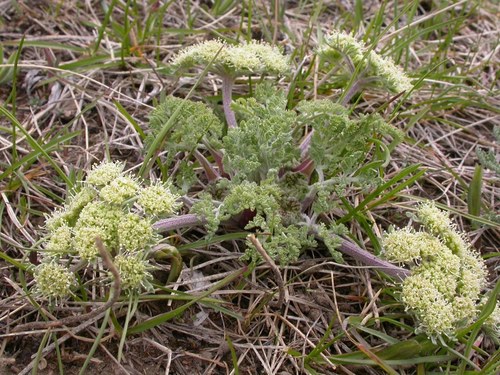


Bigseed Biscuitroot
lomatium macrocarpum
Bigseed Biscuitroot is a resilient, low-growing perennial herb native to the dry, sun-baked landscapes of western North America. Belonging to the carrot family, Apiaceae, this fascinating plant is renowned for its thick, starch-rich taproot, which was historically a vital food source for many Native American tribes who dried and ground it into a nutritious flour. In the harsh conditions of its sagebrush and prairie habitats, it stands out with its intricate, lace-like foliage and cheerful clusters of tiny flowers. As one of the early harbingers of spring, it plays a critical ecological role by providing early-season nectar to native pollinators and serving as a host plant for local butterfly larvae. Its ability to thrive in poor, rocky soils showcases the incredible adaptability of native flora.
Habitat: Found on dry, open, rocky slopes, sagebrush shrublands, and prairies across western North America.
This plant typically grows low to the ground, reaching heights of 10 to 50 cm. It is easily identified by its highly dissected, grayish-green leaves that resemble carrot foliage and are covered in fine, velvety hairs. The flowers are arranged in flat-topped, umbrella-like clusters called umbels, displaying a palette from creamy white and pale yellow to occasionally purplish hues. Following flowering, the plant produces distinctive, flattened, oblong fruits with prominent wings, measuring up to 2 cm long, which fade to a straw-like tan color as they mature.
Category
PlantsRarity
Common
Danger
1/5 · Very low
Snaps
Be the first to snap!
Its scientific species name, 'macrocarpum', translates to 'large fruit', referencing the prominent, flat, winged seeds that are remarkably large compared to other members of the celery family.
The common name 'biscuitroot' comes from the traditional practice of Indigenous peoples drying and grinding the large taproots into flour to bake durable, biscuit-like cakes.
The taproot of this plant has a distinct flavor that is often described as a combination of celery, parsnip, and mild parsley.
Possesses a deep, woody, starch-rich taproot that stores massive amounts of water and energy, allowing the plant to survive severe summer droughts and resprout in early spring.
Its leaves and stems are densely covered in fine white hairs that reflect harsh sunlight, reducing transpiration and keeping the plant cool.
Produces seeds featuring prominent, papery wings that catch the wind, helping the offspring colonize new open areas far from the parent plant.
As an autotrophic plant, it synthesizes its own food using sunlight, carbon dioxide, and water through photosynthesis, supplemented by minerals absorbed from the soil.
Papilio indra
Provides critical larval food for caterpillars of this native butterfly species.

Thomomys talpoides
The starch-rich taproots are a preferred food source, particularly during winter months.
Andrena
The open umbels provide pollen and nectar to native mining bees, assisting in pollination.
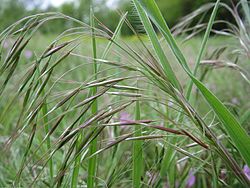
Bromus tectorum
Competes for soil moisture, light, and nutrients in degraded dry grassland habitats.
No trait badges are assigned for this object yet.
No aliases listed yet.
Collections for this object will appear here as more themes are added.
Danger
1/5 · Very low
No special safety notes yet.
Start with the whole plant, then compare leaf arrangement, leaf edges, stems and any flowers or fruit. Opposite leaves grow in pairs; alternate leaves come one at a time along the stem. These details tell you far more together than a single green leaf does. Plant Identifier: upload a photo and compare the visible details.
10-50 cm
5-20 years
As an autotrophic plant, it synthesizes its own food using sunlight, carbon dioxide, and water through photosynthesis, supplemented by minerals absorbed from the soil.
Found on dry, open, rocky slopes, sagebrush shrublands, and prairies across western North America.
Photosynthesis
Zoom in to split clusters and explore where this object has been snapped.
Recent snaps will appear here as new observations are added.

Washington, US
You might spot Red-Tailed Hawk and Colorado Checkered Whiptail.
View guide →

Washington, US
You might spot Arrowleaf Balsamroot and Canada Goose.
View guide →
Take the discovery with you
Snap it with Snappit to identify it, learn what makes it special, and add the discovery to your collection.

















