





Black-and-white Warbler
Mniotilta varia
The Black-and-white Warbler is a small bird with striking black and white stripes. It loves to hop around tree trunks and branches, searching for tasty insects to eat.
Habitat: Forests
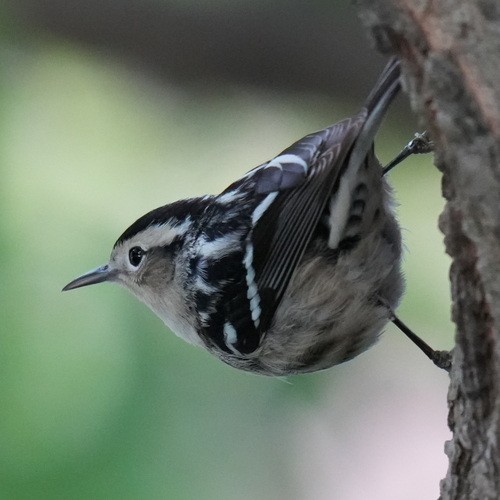
The Black-and-white Warbler is a small, streaky bird, covered in bold black and white stripes across its body and head. It has a slender bill and often appears with a distinctive creeper-like posture, helping it stand out among other warblers.
Category
BirdsRarity
Common
Danger
1/5 · Very low
Snaps
18
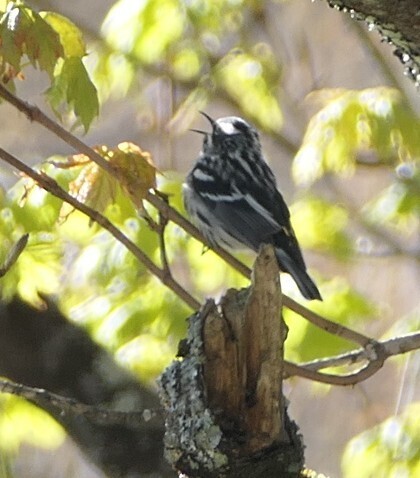
Its streaky black and white feathers help it disappear against tree bark, making it tricky to spot.
Male Black-and-white Warblers have more black on their throat and cheeks than the females.
They build cup-shaped nests hidden on the ground, often at the base of trees or under logs.
Unlike most warblers, this bird often creeps head-first down tree trunks, like a nuthatch!
Black-and-white Warbler can climb up and down tree trunks and branches like a tiny woodpecker, using its strong feet to find hidden insects.
Black-and-white Warbler has amazing navigation that helps them fly thousands of miles between continents each year.
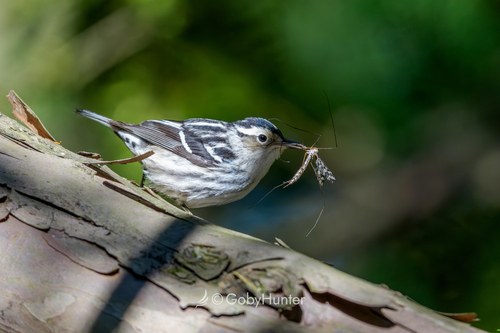
These insect-eating birds love munching on a variety of small bugs and creepy crawlies!

Accipiter striatus
A common aerial predator of small songbirds.
Malacosoma americanum
A primary food source, especially during breeding season.
.jpg&width=800)
Molothrus ater
Lays its eggs in the warbler's nest, often to the detriment of warbler chicks.
Feathered describes animals, primarily birds, possessing a covering of feathers.
Marked with parallel bands or lines of color.
Singing animals produce complex vocalizations, often for purposes of attracting mates, defending territory, or communicating within their species.
Arboreal animals live primarily in trees, utilizing them for shelter, food, and protection from predators.

This trait identifies organisms whose diet primarily consists of insects and other small invertebrates.

Forest habitats are terrestrial environments dominated by dense tree cover, supporting a high diversity of plant and animal life.

Diurnal animals are primarily active during daylight hours, typically resting or sleeping at night.
No aliases listed yet.
Danger
1/5 · Very low
Always watch birds from a distance and never try to touch or catch them.
The easiest way to identify Black-and-white Warbler is to use the Snappit nature identifier app.
11-13 cm
19-22 cm
0.008-0.015 kg
2-5 years
35 km/h
These insect-eating birds love munching on a variety of small bugs and creepy crawlies!
Forests
Zoom in to split clusters and explore where this object has been snapped.
May 22, 2026
Hunters PointPhoto attribution
(c) foxsu, some rights reserved (CC BY)
License: CC BY 4.0 ↗
Image may be shown cropped inside the card frame.
May 12, 2026
South Windham Village Historic DistrictPhoto attribution
no rights reserved
License: CC0 1.0 ↗
Image may be shown cropped inside the card frame.
May 12, 2026
Awbury ArboretumPhoto attribution
(c) GobyHunter, some rights reserved (CC BY)
License: CC BY 4.0 ↗
Image may be shown cropped inside the card frame.

Pennsylvania, US
You might spot American Robin, Red-Winged Blackbird, and Lesser Celandine.
View guide →

Arkansas, US
You might spot Widow's-Cross, Yucca Giant-Skipper, and Outis Skipper.
View guide →

New York, US
You might spot White Snakeroot, Rock Pigeon, and Eastern Gray Squirrel.
View guide →

Ontario, CA
You might spot Painted Turtle, Common Watersnake, and Pickerelweed.
View guide →

Wisconsin, US
You might spot American Cancer-Root and Eastern White Pine.
View guide →

West Virginia, US
You might spot Great Rhododendron and Mountain Laurel.
View guide →
Take the discovery with you
Snap it with Snappit to identify it, learn what makes it special, and add the discovery to your collection.




.jpg&width=800)








