

Blackroot
pterocaulon pycnostachyum
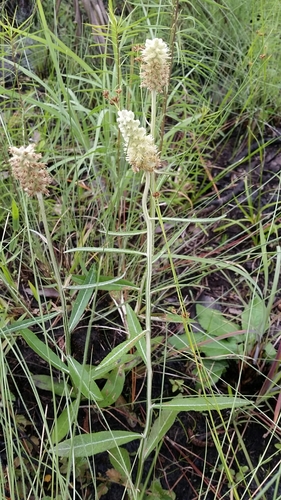
Blackroot (Pterocaulon pycnostachyum) is a striking herbaceous perennial native to the pine flatwoods and sandy coastal plains of the southeastern United States. Named for its characteristic dark, resinous roots, this resilient member of the aster family is easily recognized by its unique "winged" stems, where the leaf bases extend downward along the stalk. It stands as an important component of fire-adapted ecosystems, showing remarkable resilience to seasonal burns and drought. In late spring and summer, it produces dense, woolly, spike-like clusters of creamy white flowers that attract a diverse array of native pollinators. Historically, the plant holds a place in traditional herbalism, where its aromatic roots were utilized for various ailments, though today it is most celebrated for its ecological value in supporting wild ecosystems.
Habitat: Found in sandy pine flatwoods, sandhills, and open coastal savannas of the southeastern United States, typically in fire-maintained communities.
Blackroot grows upright to a height of 30 to 80 centimeters, featuring erect, unbranched stems that are distinctively winged with leafy tissues running vertically down their sides. The entire plant, especially the undersides of its lance-shaped leaves, is covered in a dense, silvery-white woolly pubescence, giving it a soft, dusty appearance. At the top of the stem sits a compact, cylindrical spike, measuring 2 to 10 centimeters long, packed with numerous tiny, white-to-pale-pink flower heads. Below ground, it features a thick, tough, dark brown to black taproot system.
Category
PlantsRarity
Common
Danger
1/5 · Very low
Snaps
1
Historically, native tribes and early settlers used the aromatic, black roots to brew a tea traditionally used to treat respiratory conditions, earning it the name blackroot.
The genus name Pterocaulon comes from the Greek words pteron, meaning wing, and kaulos, meaning stem, referencing the plant's unique winged appearance.
The plant is highly adapted to wildfires; regular forest fires clear out competing underbrush, allowing Blackroot to flourish and sprout rapidly from its woody taproot.
The decurrent leaves form vertical wings along the stem, helping to channel rainwater directly down to the root system and reducing water loss.
The dense coating of silvery-white hairs reflects intense sunlight, reduces transpiration, and protects the plant from drying winds.
A thick, woody, dark taproot stores energy reserves deep underground, allowing the plant to rapidly resprout after wildfires.
As a photoautotrophic plant, Blackroot generates its own energy through photosynthesis, utilizing sunlight, water, carbon dioxide, and soil nutrients.
Bombus pennsylvanicus
Visits the flowers for nectar and pollen, acting as a primary pollinator.

Odocoileus virginianus
Browses on the leaves and stems of young plants.

Gopherus polyphemus
Shares the sandy flatwood habitat and may occasionally graze on the low foliage.
No trait badges are assigned for this object yet.
No aliases listed yet.
Collections for this object will appear here as more themes are added.
Danger
1/5 · Very low
No special safety notes yet.
Start with the whole plant, then compare leaf arrangement, leaf edges, stems and any flowers or fruit. Opposite leaves grow in pairs; alternate leaves come one at a time along the stem. These details tell you far more together than a single green leaf does. Plant Identifier: upload a photo and compare the visible details.
30-80 cm
3-8 years
As a photoautotrophic plant, Blackroot generates its own energy through photosynthesis, utilizing sunlight, water, carbon dioxide, and soil nutrients.
Found in sandy pine flatwoods, sandhills, and open coastal savannas of the southeastern United States, typically in fire-maintained communities.
Photosynthesis
Zoom in to split clusters and explore where this object has been snapped.
Florida, US
You might spot Pink Sundew, Drooping Forked Fern, and Netted Pawpaw.
View guide →

Florida, US
You might spot Lady Lupine, Woolly Pawpaw, and Tarflower.
View guide →

Florida, US
You might spot Coastalplain Chaffhead, Slimleaf Pawpaw, and Woolly Pawpaw.
View guide →
Take the discovery with you
Snap it with Snappit to identify it, learn what makes it special, and add the discovery to your collection.