





Box Tree Moth
Cydalima perspectalis
The Box Tree Moth is a small, colorful insect that loves to fly around gardens and parks. Its beautiful wings can be green and brown, helping it blend in with leaves.
Habitat: Urban areas
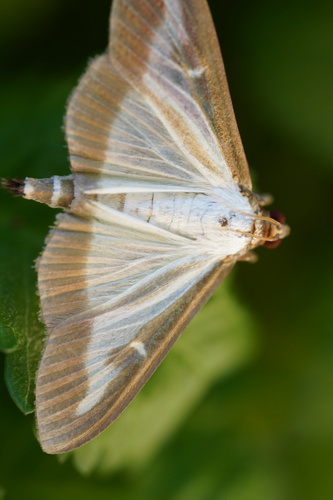
The Box Tree Moth typically has bright white wings with thick, iridescent brown borders and a distinctive white crescent mark. Some individuals can be entirely light brown or dark brown/black, but all have the unique crescent, making them visually striking.
Category
InsectsRarity
Common
Danger
1/5 · Very low
Snaps
4
Adult Box Tree Moths only live for about two weeks, but they can lay hundreds of eggs in that short time!
Its caterpillars create silk webs to protect themselves while they munch on leaves, like building a tiny fort!
Sometimes, their wings are completely dark brown, making them look totally different from the usual white ones!
This moth is considered an invasive species in many parts of the world, causing big problems for boxwood plants!
Box Tree Moth can fly at night, navigating in darkness to find flowers and mates using its sensitive antennae.
Box Tree Moth can lay hundreds of tiny eggs at once, ensuring many new caterpillars hatch to feed on boxwood plants.
Box Tree Moth caterpillars have strong mandibles that help them quickly devour boxwood leaves to grow fast.
Caterpillars are herbivores that feast exclusively on boxwood leaves, while adults sip nectar.
Age differences: Caterpillars consume boxwood leaves, but adult moths primarily feed on nectar from flowers.
Buxus sempervirens
Its caterpillars devour the leaves of this ornamental shrub.
%2C_Parc_de_Woluw%C3%A9%2C_Brussels_(13042792905).jpg&width=800)
Parus major
Some bird species, like the Great Tit, feed on its caterpillars.
Apanteles glyptobasalis
This tiny wasp lays its eggs inside the moth's caterpillars.
Solitary animals live alone for most of their lives, only interacting with others for mating or parental care.
Camouflaged describes organisms that possess coloring or patterns that allow them to blend into their environment.
Colorful describes organisms or objects displaying a wide range of bright and distinct colors.
This trait characterizes organisms whose diet consists entirely or primarily of plant material.

This habitat trait indicates species that can coexist with humans in urban and suburban environments, utilizing man-made structures and green spaces.

Nocturnal animals are primarily active during the nighttime hours, typically resting or sleeping during the day.

Describes organisms that transfer pollen, enabling the fertilization and reproduction of plants.
No aliases listed yet.
Danger
1/5 · Very low
Moths are usually safe, but it's best to watch them from a distance and not touch them.
The easiest way to identify Box Tree Moth is to use the Snappit nature identifier app.
40-45 mm
25-30 mm
8-14 days
Caterpillars are herbivores that feast exclusively on boxwood leaves, while adults sip nectar.
Urban areas
Foraging
6
Zoom in to split clusters and explore where this object has been snapped.
Aug 22, 2025
Broadway Avenue Historic DistrictPhoto attribution
no rights reserved
License: CC0 1.0 ↗
Image may be shown cropped inside the card frame.

Michigan, US
You might spot Eastern Gray Squirrel, Tree-Of-Heaven, and House Sparrow.
View guide →

Michigan, US
You might spot Monarch, Canada Goose, and Eastern Gray Squirrel.
View guide →

Michigan, US
You might spot Monarch, Canada Goose, and Eastern Gray Squirrel.
View guide →

Michigan, US
You might spot Monarch, Canada Goose, and Eastern Gray Squirrel.
View guide →

Michigan, US
You might spot Monarch, Canada Goose, and Eastern Gray Squirrel.
View guide →

Michigan, US
You might spot Monarch, Canada Goose, and Eastern Gray Squirrel.
View guide →
Take the discovery with you
Snap it with Snappit to identify it, learn what makes it special, and add the discovery to your collection.








.jpg&width=800)



