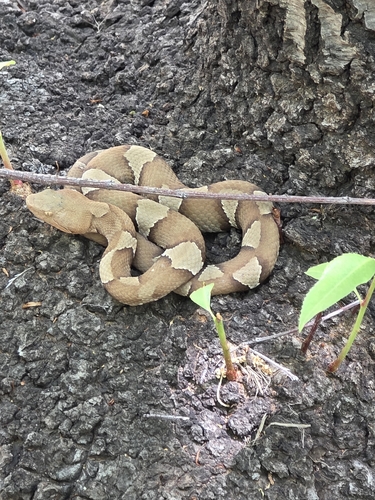
Broad-banded Copperhead
Agkistrodon laticinctus
The Broad-banded Copperhead is a snake with beautiful patterns on its skin. It has a wide, banded appearance that helps it blend into the forest floor, making it a special part of nature.
Habitat: Forests
The Broad-banded Copperhead is a medium-sized venomous snake, featuring striking hourglass-shaped bands that are broad and dark reddish-brown against a lighter copper or tan background. Its head is distinctly copper-colored, making it visually distinct from many other snakes.
Category
ReptilesRarity
Common
Danger
3/5 · Moderate
Snaps
6
Baby copperheads have a bright yellow tail tip, which they wiggle to lure prey!
Copperheads get their name from the reddish-brown color of their head.
These snakes are born live, not from eggs laid in a nest.
They are often found near streams and rocky areas, or under logs.
Broad-banded Copperhead can 'see' heat using special pit organs, which helps them hunt warm-blooded prey in the dark.
Broad-banded Copperhead has a unique banded pattern that helps them blend seamlessly into leaf litter and forest floors.
Broad-banded Copperhead can rapidly vibrate its tail when threatened, warning predators to stay away.
Broad-banded Copperhead can inject mild venom, which helps them overpower small prey quickly.
These snakes are carnivores, mostly eating small rodents and frogs.

Peromyscus leucopus
A common prey item in their woodland habitats.
%2C_Vorderansich.jpg&width=800)
Lithobates sphenocephalus
Frequently preys on frogs near water sources.
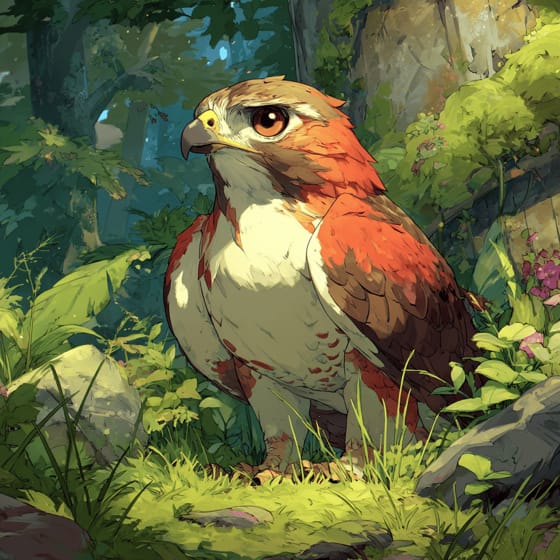
Buteo jamaicensis
Large birds of prey can hunt copperheads.
Coluber constrictor
Larger, non-venomous snakes may prey on them.
Solitary animals live alone for most of their lives, only interacting with others for mating or parental care.
Camouflaged describes organisms that possess coloring or patterns that allow them to blend into their environment.
Colorful describes organisms or objects displaying a wide range of bright and distinct colors.
An ambush predator hunts by patiently waiting and concealing itself, then launching a sudden attack when unsuspecting prey comes within range.

Forest habitats are terrestrial environments dominated by dense tree cover, supporting a high diversity of plant and animal life.

This trait identifies organisms whose diet consists entirely or primarily of animal tissue.

Nocturnal animals are primarily active during the nighttime hours, typically resting or sleeping during the day.

Venomous organisms produce toxins that are injected into another animal, typically through a bite or sting.
No aliases listed yet.
Danger
3/5 · Moderate
If you see a snake, it's best to stay calm and walk away. Snakes like to be left alone.
The easiest way to identify Broad-banded Copperhead is to use the Snappit nature identifier app.
60-90 cm
0.1-0.3 kg
15-20 years
5 km/h
These snakes are carnivores, mostly eating small rodents and frogs.
Forests
Ambush
Zoom in to split clusters and explore where this object has been snapped.
May 20, 2026
Chihuahuan Desert Nature Center and Botanical GardensPhoto attribution
(c) Cleveland Powell, some rights reserved (CC BY)
License: CC BY 4.0 ↗
Image may be shown cropped inside the card frame.

Texas, US
You might spot Texas Hedgehog Cactus, Ornate Tree Lizard, and Cactus Wren.
View guide →
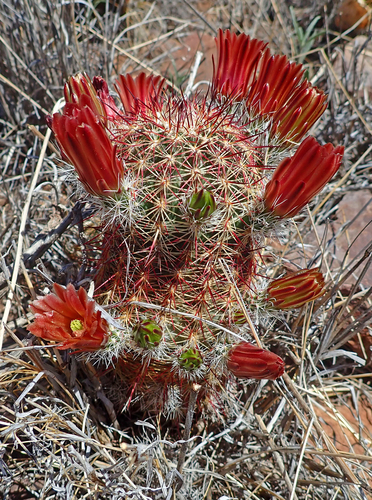
Texas, US
You might spot Texas Hedgehog Cactus, Cactus Wren, and Ornate Tree Lizard.
View guide →

Texas, US
You might spot Leonora's Dancer and Ornate Tree Lizard.
View guide →

Texas, US
You might spot Yellow-Crowned Night Heron, Duck, and Wood Duck.
View guide →
Take the discovery with you
Snap it with Snappit to identify it, learn what makes it special, and add the discovery to your collection.