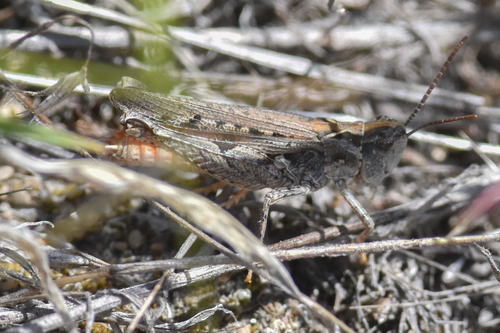





Brown-spotted Range Grasshopper
Psoloessa delicatula
The Brown-spotted Range Grasshopper is a small, hopping insect with lovely brown spots. They love to jump around in grassy areas and are fun to watch as they leap from plant to plant!
Habitat: Grasslands
The Brown-spotted Range Grasshopper is a slender insect with excellent camouflage. It has a mottled pattern of brown, tan, and gray spots, allowing it to blend seamlessly into dry grass and soil. Its long hind legs often feature faint dark bands, providing subtle visual breaks.
Category
InsectsRarity
Common
Danger
1/5 · Very low
Snaps
Be the first to snap!
Wow! Baby grasshoppers, called nymphs, hatch looking like tiny adults!
Wow! Their 'ears' are actually on their abdomen, not their head!
Wow! They can change their color to blend perfectly with dry ground!
Wow! They help spread tiny plant seeds as they munch on grasses!
Brown-spotted Range Grasshopper has a speckled body pattern that helps them vanish into dry rangeland, avoiding watchful predators.
Brown-spotted Range Grasshopper can launch itself high and far because of its strong hind legs, quickly escaping danger.
Brown-spotted Range Grasshopper produces chirping sounds by rubbing its hind legs against its wings, which helps them communicate and attract mates.
This small insect is an herbivore, munching on grasses and other small plants in its habitat.

Falco sparverius
a common prey item for this small falcon.

Pica hudsonia
provides a high-protein meal for omnivorous birds.
Bouteloua gracilis
grazes on the abundant grasses of its prairie home.

Crotalus viridis
a crunchy snack for reptiles in its ecosystem.
Marked with spots or patches of a different color.
Solitary animals live alone for most of their lives, only interacting with others for mating or parental care.
Camouflaged describes organisms that possess coloring or patterns that allow them to blend into their environment.
Grassland habitats are terrestrial biomes dominated by grasses and herbaceous plants, supporting a variety of grazing animals.
This trait characterizes organisms whose diet consists entirely or primarily of plant material.
Diurnal animals are primarily active during daylight hours, typically resting or sleeping at night.
This trait identifies organisms that exhibit exceptional swiftness in movement for hunting, escape, or travel.
Describes organisms that transfer pollen, enabling the fertilization and reproduction of plants.
No aliases listed yet.
Danger
1/5 · Very low
Be gentle if you see one and don't touch it too hard, as they can easily get scared.
Look for six legs, antennae, three body sections and the shape of the wings. Beetles have hardened front wings; flies have just one working pair. Tiny insects may need a close view before their group is clear. Insect Identifier: upload a photo and compare the visible details.
20-30 mm
15-25 mm
60-120 days
5 km/h
This small insect is an herbivore, munching on grasses and other small plants in its habitat.
Grasslands
Grazing
Zoom in to split clusters and explore where this object has been snapped.
Recent snaps will appear here as new observations are added.
Take the discovery with you
Snap it with Snappit to identify it, learn what makes it special, and add the discovery to your collection.