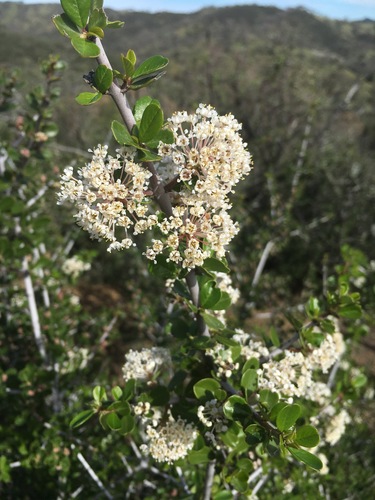


Buckbrush
ceanothus cuneatus
Buckbrush (Ceanothus cuneatus) is an iconic, rugged evergreen shrub native to the chaparral, oak woodlands, and dry coniferous forests of western North America. Renowned for its incredible resilience, this stiffly branched woody plant is a cornerstone species of Mediterranean climates, thriving on dry, rocky slopes where other plants struggle. Its intricate, interlocking branches provide critical shelter for small mammals and nesting birds, while its deep root system secures fragile hillside soils against erosion. During the spring, Buckbrush transforms the dry landscape with a spectacular burst of tiny, fragrant flower clusters that draw a wide variety of native bees, butterflies, and other pollinators. It is also an essential forage plant, offering vital nutrients to deer and elk during harsh winter months. One of its most fascinating ecological roles is its adaptation to fire; its seeds remain dormant in the soil for decades, waiting for the heat of a wildfire to trigger their growth, ensuring the rapid regeneration of the post-fire chaparral ecosystem.
Habitat: Typically found on dry, rocky slopes, chaparral ridges, and open oak or pine woodlands across western North America.
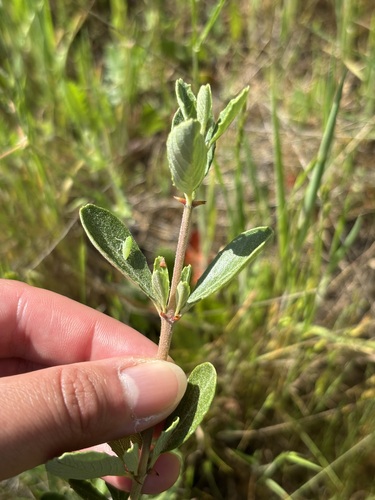
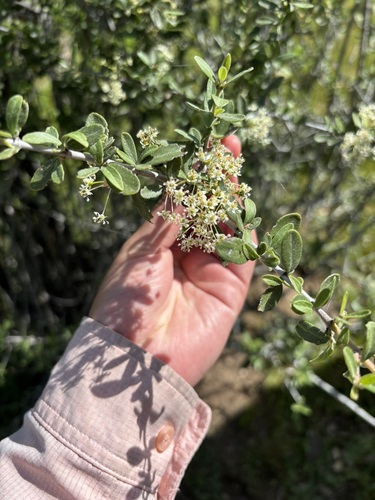
Buckbrush is a highly branched, rigid shrub growing up to 3 meters tall, recognizable by its stiff, greyish-green woody stems that often terminate in sharp, thorn-like twigs. Its leaves are small, thick, and wedge-shaped, typically measuring 0.5 to 2 centimeters long, with smooth margins and a dull green upper surface. In spring, it produces dense, rounded clusters of tiny, five-petaled flowers that range from stark white to cream, and occasionally pale blue or lavender, followed by small, round, three-lobed seed capsules featuring distinctive horn-like projections.
Category
PlantsRarity
Common
Danger
1/5 · Very low
Snaps
4
A single mature Buckbrush plant can produce thousands of seeds that can remain viable, buried in the soil seed bank, for over a century waiting for fire.
Indigenous peoples historically used the rigid, straight branches of Buckbrush to craft durable arrows, digging sticks, and complex woven baskets.
The fresh blossoms contain natural saponins; when crushed and vigorously rubbed with water, they produce a gentle, fragrant lather used as soap.
The seeds of Buckbrush possess a tough, water-impermeable coat that allows them to lie dormant in the soil for decades until the intense heat of a wildfire cracks the coat and triggers germination.
Buckbrush forms a mutualistic relationship with Frankia bacteria in its root nodules, allowing it to convert atmospheric nitrogen into a usable form, enriching nutrient-poor soils.
Features thick, leathery, sclerophyllous leaves and a deep root system designed to conserve water and survive hot, dry Mediterranean summers.
As a photosynthetic autotroph, Buckbrush produces its own chemical energy by capturing sunlight and converting carbon dioxide and water into sugars.
Frankia alni
Provides critical nitrogen-fixing capabilities in root nodules through a symbiotic partnership.
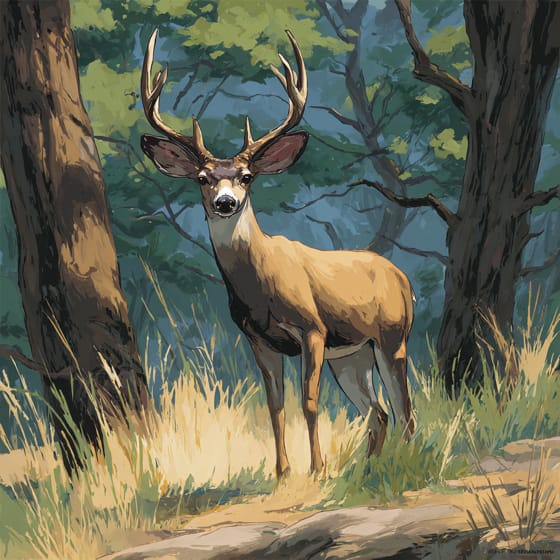
Odocoileus hemionus
Serves as an essential winter browse food source for grazing herbivores on chaparral slopes.

Hyalophora euryalus
Acts as a larval host plant, where caterpillars feed on the leaves before pupating.
No trait badges are assigned for this object yet.
No aliases listed yet.
Collections for this object will appear here as more themes are added.
Danger
1/5 · Very low
No special safety notes yet.
The easiest way to identify Buckbrush is to use the Snappit nature identifier app.
100-300 cm
20-80 years
As a photosynthetic autotroph, Buckbrush produces its own chemical energy by capturing sunlight and converting carbon dioxide and water into sugars.
Typically found on dry, rocky slopes, chaparral ridges, and open oak or pine woodlands across western North America.
Photosynthesis
Zoom in to split clusters and explore where this object has been snapped.
Mar 15, 2026
San Joaquin Experimental RangePhoto attribution
(c) Nina S. Zhao, some rights reserved (CC BY)
License: CC BY 4.0 ↗
Image may be shown cropped inside the card frame.
Mar 15, 2026
San Joaquin Experimental RangePhoto attribution
(c) Nina S. Zhao, some rights reserved (CC BY)
License: CC BY 4.0 ↗
Image may be shown cropped inside the card frame.

California, US
You might spot Toyon, Mule Deer, and White Globe Lily.
View guide →

California, US
You might spot Gray Pine, Gambel Oak, and Caterpillar Scorpionweed.
View guide →

California, US
You might spot Hoary Rock-Rose, Brittleleaf Manzanita, and Chaparral Pea.
View guide →
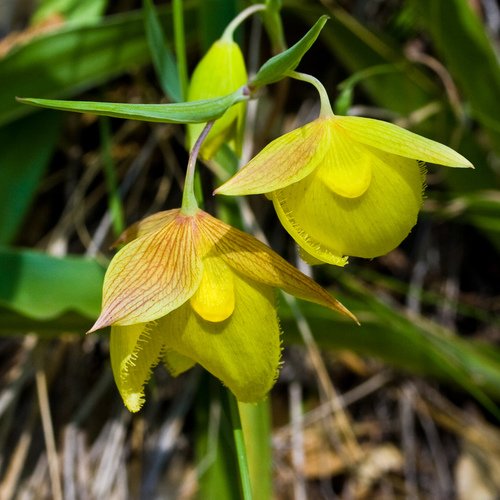
California, US
You might spot Mount Diablo Fairy-Lantern and Western Fence Lizard.
View guide →
Take the discovery with you
Snap it with Snappit to identify it, learn what makes it special, and add the discovery to your collection.











.jpg&width=800)



_001.jpg&width=800)




