





Canadian bunchberry
Cornus canadensis
The Canadian bunchberry is a small plant with pretty white flowers that look like stars! It grows close to the ground and has shiny green leaves that turn red in the fall.
Habitat: Forests
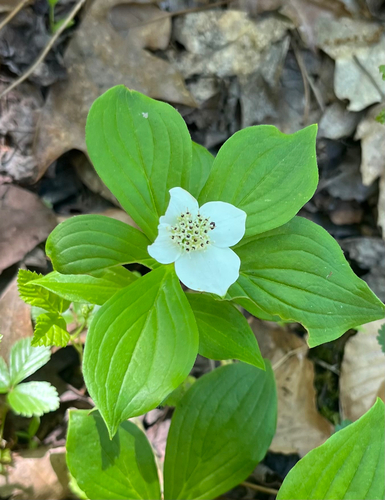
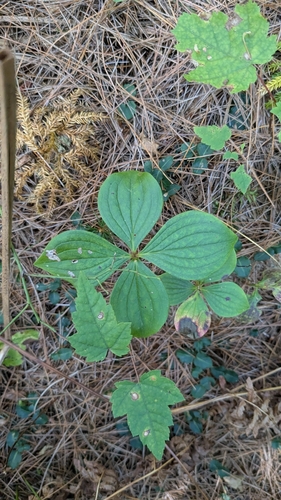
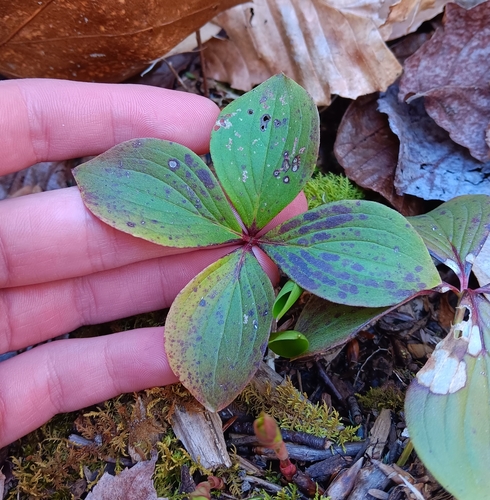
The Canadian bunchberry is a small perennial plant with a whorl of 4-7 dark green leaves near the top of its stem. It features a cluster of tiny greenish-yellow flowers surrounded by four prominent, showy white bracts, resembling a single large flower. These develop into a tight cluster of bright red, edible berries in late summer.
Category
PlantsRarity
Common
Danger
1/5 · Very low
Snaps
37
Its bright red berries stay on the plant well into the fall, adding a splash of color!
Its tiny flowers are surrounded by four white 'petals' that are actually modified leaves!
Many Indigenous peoples traditionally ate bunchberries and used them for medicine.
This plant uses clever 'piston' traps to launch pollen onto visiting insects!
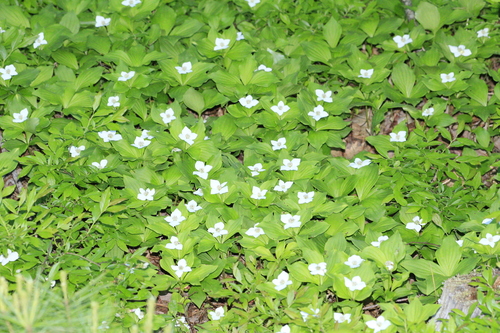
Canadian bunchberry has underground stems (rhizomes) that help it spread and form dense carpets, covering the forest floor.
Canadian bunchberry has four large, white 'petals' (bracts) that act like a giant advertisement to attract pollinators to its tiny true flowers.
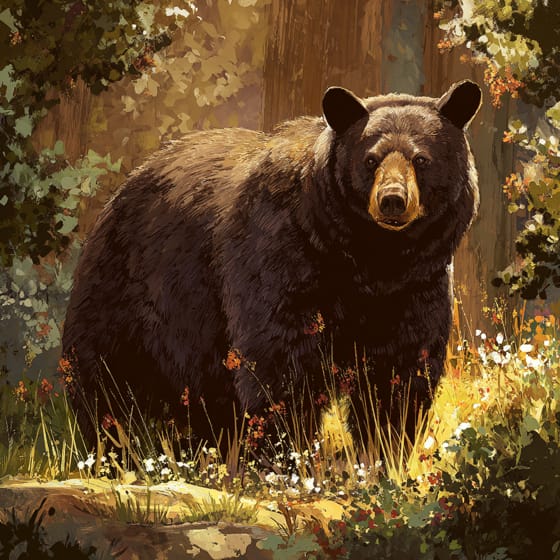
Ursus americanus
Berries are a food source.
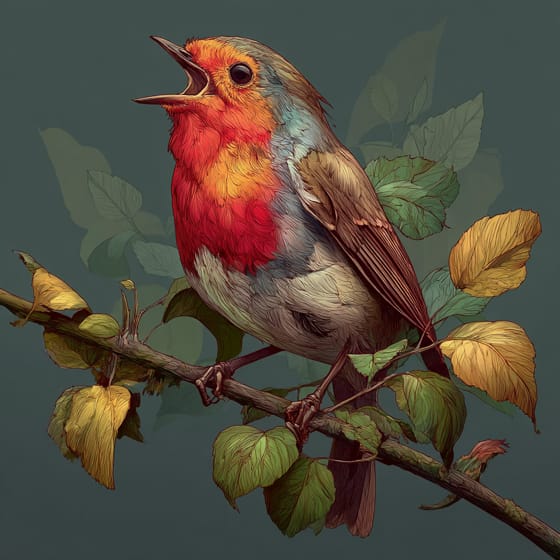
Turdus migratorius
Birds feed on the red berries.
Bombus impatiens
Relies on insects for pollination services.

Odocoileus virginianus
Deer browse on its leaves.
Deciduous plants periodically shed all their leaves, typically during autumn or dry seasons.
Flowering plants are any plants that produce flowers as part of their reproductive cycle.
Cluster flowers are inflorescences where individual flowers are arranged closely together on a common stem.
Shade tolerant plants are adapted to grow and thrive in areas with low light levels, requiring less direct sunlight.

Fruit-bearing plants produce fruits, which are the mature ovaries of flowering plants containing seeds.

Edible plants are those parts of a plant that are considered safe for human consumption.

Fall color refers to the seasonal change in foliage pigmentation, primarily in deciduous plants, displaying vibrant hues.

Describes plants that are particularly attractive and beneficial to a wide range of pollinating organisms.

Forest habitats are terrestrial environments dominated by dense tree cover, supporting a high diversity of plant and animal life.
No aliases listed yet.
Danger
1/5 · Very low
Always ask an adult before picking any berries or plants.
The easiest way to identify Canadian bunchberry is to use the Snappit nature identifier app.
10-20 cm
15-30 cm
0.5-1 cm
Late spring to early summer
Yes
None
Perennial
Zoom in to split clusters and explore where this object has been snapped.
Jun 3, 2026
Binghamton Zoo at Ross ParkPhoto attribution
(c) Christina S. Baer, some rights reserved (CC BY)
License: CC BY 4.0 ↗
Image may be shown cropped inside the card frame.
May 30, 2026
Rockport Historic DistrictPhoto attribution
no rights reserved
License: CC0 1.0 ↗
Image may be shown cropped inside the card frame.
Sep 12, 2025
Quehanna Wild AreaPhoto attribution
(c) Matt Schenck, some rights reserved (CC BY)
License: CC BY 4.0 ↗
Image may be shown cropped inside the card frame.
Apr 25, 2024
The MonolithsPhoto attribution
(c) Tyler Ekholm, some rights reserved (CC BY)
License: CC BY 4.0 ↗
Image may be shown cropped inside the card frame.

Maine, US
You might spot American Bullfrog and Three-Toothed Cinquefoil.
View guide →

Michigan, US
You might spot Eastern Skunk Cabbage and Kirtland's Warbler.
View guide →

Maine, US
You might spot Ghost Pipe, Pink Lady's Slipper, and Bluebead Lily.
View guide →

Maine, US
You might spot Rugosa Rose and European Green Crab.
View guide →

Maine, US
You might spot Pink Lady's Slipper, Wood Lily, and Great Blue Heron.
View guide →

Pennsylvania, US
You might spot Steeplebush, Elk, and Eastern Newt.
View guide →
Take the discovery with you
Snap it with Snappit to identify it, learn what makes it special, and add the discovery to your collection.





.jpg&width=800)



_001.jpg&width=800)


