





chamise
Adenostoma fasciculatum
Chamise is a bushy plant that grows in sunny places. It has thin, needle-like leaves and can be very tall. This plant helps keep the soil strong and provides homes for small animals.
Habitat: Mountain regions
The chamise has tiny, bright green, needle-like leaves clustered densely on reddish-brown stems. It produces abundant creamy-white flowers in feathery spikes, giving the shrub a frosted appearance. Its thick, upright growth forms dense, unmistakable thickets.
Category
PlantsRarity
Common
Danger
1/5 · Very low
Snaps
4
Chamise is sometimes called 'greasewood' because its leaves feel oily and waxy!
It forms huge, dense thickets, creating natural green walls where few animals can easily pass!
This tough shrub can live for over 100 years, growing new stems even after fires!
When chamise burns, the smoke can actually help the seeds of other plants sprout!
Chamise has tiny, resinous leaves that help it reduce water loss and survive long, dry summers.
This plant resprouts from its base after wildfires and quickly colonizes burned areas, thriving with fire.
Apis mellifera
bees gather its nectar and pollen
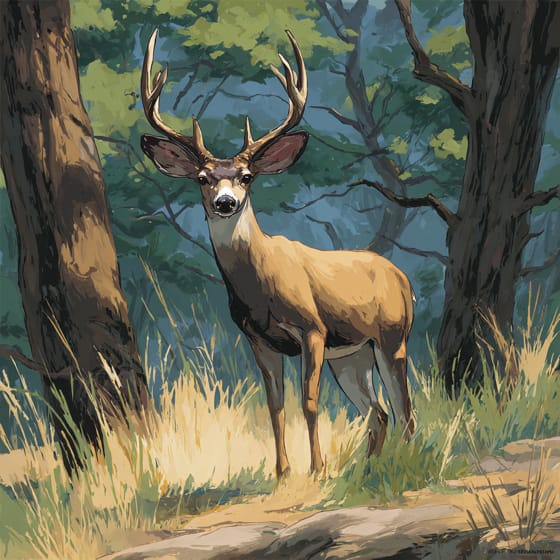
Odocoileus hemionus
deer browse its leaves and twigs

Pipilo crissalis
provides dense cover for nesting birds

Sylvilagus audubonii
rabbits find safe hiding spots within its thickets
Flowering plants are any plants that produce flowers as part of their reproductive cycle.
A shrub is a woody plant smaller than a tree, typically with multiple stems branching from or near the ground.
Evergreen plants retain their foliage throughout the year, never shedding all their leaves at once.
Drought-tolerant plants can survive and flourish in conditions with limited water availability.

This habitat trait identifies species found in mountainous regions, characterized by high elevation, steep slopes, and varying climate zones.

Describes a species whose presence and role have a disproportionately large effect on its environment.
No aliases listed yet.
Danger
1/5 · Very low
Be careful when exploring around chamise bushes; they can be prickly!
The easiest way to identify chamise is to use the Snappit nature identifier app.
100-300 cm
100-250 cm
0.3-0.5 cm
Late spring to early summer
No
None
Perennial
Zoom in to split clusters and explore where this object has been snapped.

California, US
You might spot Warrior's Plume and Purple Owl's-Clover.
View guide →

California, US
You might spot Peridot Sweat Bee and Western Fence Lizard.
View guide →

California, US
You might spot Western Fence Lizard and California Poppy.
View guide →

California, US
You might spot Hoary Rock-Rose, Brittleleaf Manzanita, and Chaparral Pea.
View guide →

California, US
You might spot Sonoma Sage, White Globe Lily, and Mute Swan.
View guide →

California, US
You might spot California Buckwheat, Chaparral Yucca, and White Sage.
View guide →
Take the discovery with you
Snap it with Snappit to identify it, learn what makes it special, and add the discovery to your collection.








.jpg&width=800)



_001.jpg&width=800)



