





clasping Venus's looking glass
Triodanis perfoliata
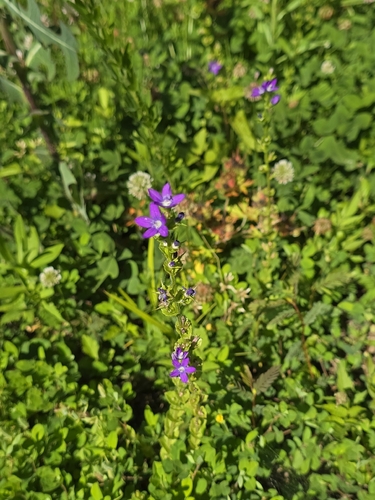
Clasping Venus's looking glass is a pretty plant with small, star-shaped flowers. It often grows in sunny places and can be found in fields and along roadsides.
Habitat: Grasslands
The clasping Venus's looking glass has slender, upright stems with distinctive, rounded leaves that completely encircle and 'clasp' the stem. Its small, star-like flowers are typically vibrant purple-blue, sometimes white, emerging from the leaf axils.
Category
PlantsRarity
Common
Danger
1/5 · Very low
Snaps
19
Its tiny seeds can stay hidden in the soil for years, patiently waiting for the perfect moment to sprout!
Some of its flowers never even open, doing a secret self-pollination inside!
The name 'looking glass' likely refers to its smooth, shiny leaves that can reflect light!
This plant is a champion at growing in disturbed places like sidewalks and old fields!
Clasping Venus's looking glass can produce tiny, hidden flowers that never open but still make seeds, ensuring survival.
Clasping Venus's looking glass has unique leaves that wrap entirely around its stem, potentially collecting water droplets.
Clasping Venus's looking glass grows rapidly from seed to flower in one season, helping it colonize new areas fast.
Apis mellifera
Visits open flowers for nectar and pollen
Bombus impatiens
Another key pollinator for its showy flowers
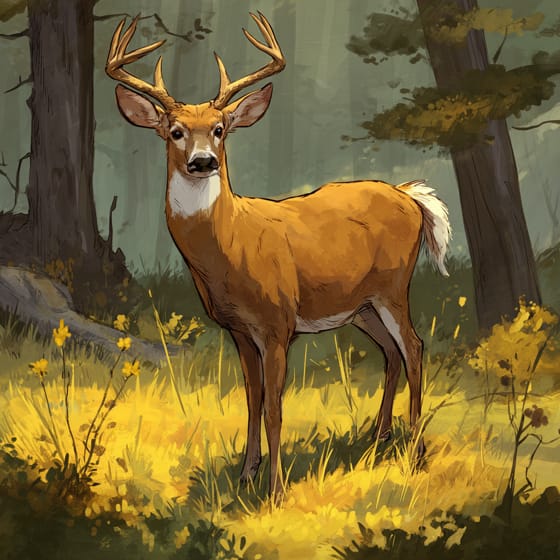
Odocoileus virginianus
Young plants may be browsed by deer
Ornamental plants are cultivated primarily for their aesthetic appeal, enhancing landscapes and gardens with their attractive foliage, flowers, or form.
Biennial plants complete their life cycle over two growing seasons, typically forming foliage in the first year and flowering/seeding in the second.
Spring blooming plants produce their flowers during the spring season, often signifying the end of winter and the start of new growth.
Fragrant flowers emit a pleasant aroma, often to attract pollinators or for defense.

Colorful describes organisms or objects displaying a wide range of bright and distinct colors.

Grassland habitats are terrestrial biomes dominated by grasses and herbaceous plants, supporting a variety of grazing animals.

Describes plants that are particularly attractive and beneficial to a wide range of pollinating organisms.
No aliases listed yet.
Danger
1/5 · Very low
Always look but don't touch plants unless you know they are safe.
The easiest way to identify clasping Venus's looking glass is to use the Snappit nature identifier app.
10-60 cm
1-2 cm
Late spring to early summer
Yes
None
Annual
Insect
Zoom in to split clusters and explore where this object has been snapped.
Jun 2, 2026
Aurora Highlands Historic DistrictPhoto attribution
(c) Steve Young, some rights reserved (CC BY)
License: CC BY 4.0 ↗
Image may be shown cropped inside the card frame.

Maryland, US
You might spot Crane-Fly Orchid, Fragile Forktail, and Ebony Jewelwing.
View guide →

Rhode Island, US
You might spot Spotted Lanternfly, Duck, and American Robin.
View guide →

Arkansas, US
You might spot Widow's-Cross, Yucca Giant-Skipper, and Outis Skipper.
View guide →

US
You might spot Firewheel, Domestic Horse, and Atlantic Horseshoe Crab.
View guide →

Pennsylvania, US
You might spot Canada Goose, American Robin, and Red-Winged Blackbird.
View guide →

New Jersey, US
You might spot American Beech, Garlic Mustard, and Spotted Lanternfly.
View guide →
Take the discovery with you
Snap it with Snappit to identify it, learn what makes it special, and add the discovery to your collection.









.jpg&width=800)


_001.jpg&width=800)




