

Coastal Plain Honeycombhead
balduina angustifolia
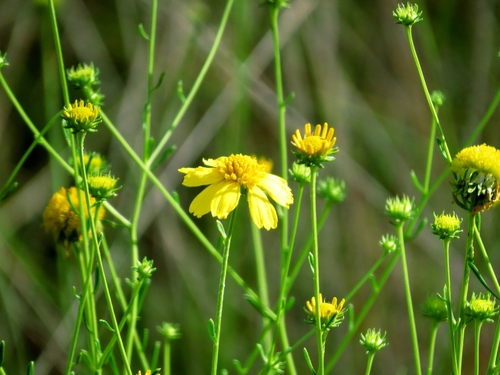
The Coastal Plain Honeycombhead is an eye-catching, sunshine-yellow wildflower native to the sandy, fire-adapted ecosystems of the southeastern United States. Standing tall on slender stems, this annual or biennial plant lights up pine flatwoods, sandhills, and coastal dunes from late summer into autumn. What makes it truly remarkable is its post-bloom transformation: once the bright yellow ray and disk florets fade and fall away, they reveal a deeply pitted, grid-like seed head that looks exactly like a miniature, pale-yellow honeycomb. This resilient species thrives in nutrient-poor, sandy soils where few other plants can compete, utilizing deep taproots and specialized leaves to survive intense summer heat. It serves as a vital late-season pollen and nectar source for a diverse array of native bees, butterflies, and other pollinators preparing for the cooler months.
Habitat: Found in dry, sandy soils of open pine flatwoods, sandhills, scrub, and coastal dunes throughout the southeastern United States.
This plant typically grows 30 to 90 cm tall, featuring erect, purplish, multi-branched stems covered in narrow, linear leaves that sit close to the stem. The showy, composite flower heads are about 2 to 3 cm wide, boasting vibrant yellow ray petals surrounding a slightly darker, domed yellow center of disk flowers. After the petals drop, the remaining seed receptacle becomes its most distinctive feature: a dry, cream-to-gray dome covered in distinct hexagonal pits, perfectly mimicking a honeycomb structure.
Category
PlantsRarity
Common
Danger
1/5 · Very low
Snaps
Be the first to snap!
The botanical genus name Balduina honors the American physician and botanist William Baldwin.
The honeycomb structure left behind after seeding is so sturdy that it can persist on the dead stem throughout the winter.
Unlike many other yellow composites, the ray flowers of the Honeycombhead remain brilliant yellow and do not fade to brown immediately upon pollination.
The deeply pitted, honeycomb-like receptacle structurally protects developing seeds from wind and minor herbivory until they are fully mature.
Narrow, resinous leaves minimize surface area and water loss, allowing the plant to thrive in dry, scorching sand.
Thrives in fire-prone ecosystems, quickly colonizing open, ash-rich sandy patches created by wildfires.
Generates its own energy through photosynthesis, using sunlight, carbon dioxide, and water while absorbing essential minerals from dry, sandy soils.

Megachile albitarsis
Pollinated by native leafcutter bees seeking nectar and pollen during the late summer nesting season.

Gopherus polyphemus
Shares its fire-maintained sandhill habitat, where the tortoise's burrowing activities clear sand patches perfect for honeycombhead germination.
No trait badges are assigned for this object yet.
No aliases listed yet.
Collections for this object will appear here as more themes are added.
Danger
1/5 · Very low
No special safety notes yet.
Start with the whole plant, then compare leaf arrangement, leaf edges, stems and any flowers or fruit. Opposite leaves grow in pairs; alternate leaves come one at a time along the stem. These details tell you far more together than a single green leaf does. Plant Identifier: upload a photo and compare the visible details.
30-90 cm
1-2 years
Generates its own energy through photosynthesis, using sunlight, carbon dioxide, and water while absorbing essential minerals from dry, sandy soils.
Found in dry, sandy soils of open pine flatwoods, sandhills, scrub, and coastal dunes throughout the southeastern United States.
14-28 days
Zoom in to split clusters and explore where this object has been snapped.
Recent snaps will appear here as new observations are added.

Florida, US
You might spot Lady Lupine, Woolly Pawpaw, and Tarflower.
View guide →
Florida, US
You might spot White-Tailed Deer, American Alligator, and Garberia.
View guide →
Take the discovery with you
Snap it with Snappit to identify it, learn what makes it special, and add the discovery to your collection.