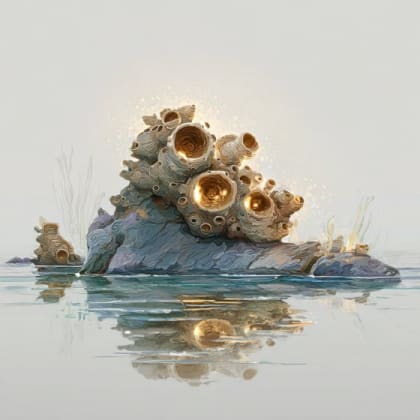
Common Atlantic Slippersnail
crepidula fornicata
The Common Atlantic Slippersnail is a little sea creature that loves to hang out on the ocean floor! It has a unique shell that looks like a tiny slipper, making it a fun find on beach adventures.
Habitat: Commonly found in marine environments along the Atlantic coast.
The Common Atlantic Slippersnail has an oval, flattened shell, often off-white, yellow, or light brown. Its most distinctive feature is an internal, shelf-like partition that resembles a small slipper, making it unique from other marine snails.
Category
InvertebrateRarity
Common
Danger
0/5 · No known danger
Snaps
9
A slippersnail can spend its whole life attached to just one spot.
These snails were accidentally spread worldwide by hitchhiking on oyster shipments.
They can glue themselves tightly to surfaces, making them very hard to remove!
They lay their tiny eggs in protective capsules under their shells!
Common Atlantic Slippersnail can change its sex from male to female as it grows, which helps them adapt to group living.
Common Atlantic Slippersnail has a strong foot that helps them stick to each other, forming tall, living stacks or chains.
Common Atlantic Slippersnail can filter tiny food particles from the water, which helps them find food and keep water clean.
This snail sips up tiny floating bits of food, like invisible plant soup, right from the water.
Age differences: null
Carcinus maenas
A common predator in their habitat.
Asterias rubens
Starfish prey on many shellfish.

Crassostrea virginica
Often attaches to oyster shells for support.
Social animals live in organized groups, cooperating for survival benefits such as foraging, defense, and raising offspring.
Filter feeders obtain nutrients by straining suspended food particles and small organisms from water.
This trait characterizes organisms whose diet consists entirely or primarily of plant material.
Describes organisms that break down dead organic material, recycling nutrients back into the ecosystem.

Aquatic habitats encompass environments where organisms live predominantly in water, including oceans, rivers, lakes, and wetlands.

Marine habitats encompass all saltwater environments of the Earth's oceans, supporting an immense diversity of aquatic life.
Danger
0/5 · No known danger
No special safety notes yet.
The easiest way to identify Common Atlantic Slippersnail is to use the Snappit nature identifier app.
up to 50 mm
up to 5 g
up to 10 years
This snail sips up tiny floating bits of food, like invisible plant soup, right from the water.
Commonly found in marine environments along the Atlantic coast.
Filter Feeding
up to 20000 g
Zoom in to split clusters and explore where this object has been snapped.

Rhode Island, US
You might spot Rugosa Rose and American Herring Gull.
View guide →

US
You might spot Firewheel, Domestic Horse, and Atlantic Horseshoe Crab.
View guide →

Maine, US
You might spot American Bullfrog and Three-Toothed Cinquefoil.
View guide →

Connecticut, US
You might spot Brant, American Herring Gull, and Double-Crested Cormorant.
View guide →

US
You might spot Rugosa Rose and American Herring Gull.
View guide →

Connecticut, US
You might spot Duck, Painted Turtle, and Great Blue Heron.
View guide →
Take the discovery with you
Snap it with Snappit to identify it, learn what makes it special, and add the discovery to your collection.