





Common Eastern Velvet Ant
Dasymutilla occidentalis
The Common Eastern Velvet Ant is a fuzzy, colorful insect that looks like a fluffy ant but is actually a wasp! They are known for their bright colors and can be found in many places.
Habitat: Grasslands
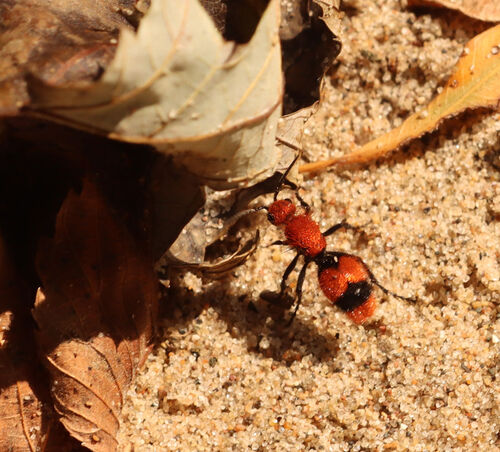
The Common Eastern Velvet Ant is a vibrant, fuzzy insect, often seen in striking red, orange, or gold and black patterns. Females are wingless and resemble large, hairy ants, while males have dark, translucent wings. Its bold colors serve as a clear warning to predators.
Category
InsectsRarity
Common
Danger
3/5 · Moderate
Snaps
11
Female velvet ants are completely wingless, making them look like fuzzy ants.
Their sting is famously ranked as one of the most painful insect stings!
Their tough bodies are so strong, they can be hard to crush!
When disturbed, they can make a unique squeaking sound to scare predators.
Common Eastern Velvet Ant can deliver a famously painful sting that helps them deter predators effectively.
Common Eastern Velvet Ant has an incredibly tough exoskeleton that helps them resist crushing and other attacks.
Common Eastern Velvet Ant has bright warning colors that helps them look dangerous, even to animals that avoid stinging insects.
Common Eastern Velvet Ant can make a distinct squeaking sound by rubbing body parts that helps them warn off potential threats.
Adults sip flower nectar; larvae are tiny bug eaters who live on hosts.
Age differences: Larvae are parasites of other insect larvae, but adults feed on flower nectar.

Bombus impatiens
Larvae grow inside their ground-nesting cocoons.
Colletes inaequalis
Larvae grow inside their ground-nesting cocoons.
Sphex pensylvanicus
Larvae grow inside their ground-nesting cocoons.
Furry describes animals possessing a dense covering of soft hair or fur.
Solitary animals live alone for most of their lives, only interacting with others for mating or parental care.
Colorful describes organisms or objects displaying a wide range of bright and distinct colors.
Grassland habitats are terrestrial biomes dominated by grasses and herbaceous plants, supporting a variety of grazing animals.

This trait identifies organisms whose diet consists entirely or primarily of animal tissue.

Venomous organisms produce toxins that are injected into another animal, typically through a bite or sting.

Describes organisms that transfer pollen, enabling the fertilization and reproduction of plants.
Danger
3/5 · Moderate
Look but don't touch! These insects can sting if they feel threatened.
The easiest way to identify Common Eastern Velvet Ant is to use the Snappit nature identifier app.
19-25 mm
30-90 days
Adults sip flower nectar; larvae are tiny bug eaters who live on hosts.
Grasslands
Parasitic
6
Zoom in to split clusters and explore where this object has been snapped.
Sep 9, 2025
Marked Tree Lock and SiphonsPhoto attribution
(c) hr_dragonfly, some rights reserved (CC BY)
License: CC BY 4.0 ↗
Image may be shown cropped inside the card frame.

Alabama, US
You might spot Anole, Eastern Gray Squirrel, and Asian Lady Beetle.
View guide →

Georgia, US
You might spot Gulf Fritillary, Anole, and American Beautyberry.
View guide →

Alabama, US
You might spot Anole, Bee, and Bristle Thistle.
View guide →

Alabama, US
You might spot Anole, Eastern Gray Squirrel, and Asian Lady Beetle.
View guide →

Alabama, US
You might spot Anole, Bee, and Bristle Thistle.
View guide →

Alabama, US
You might spot Anole, Eastern Gray Squirrel, and Asian Lady Beetle.
View guide →
Take the discovery with you
Snap it with Snappit to identify it, learn what makes it special, and add the discovery to your collection.






.jpg&width=800)



