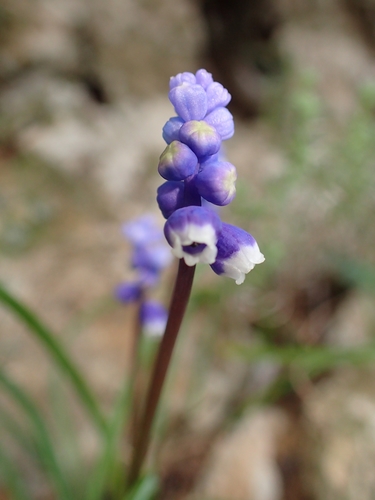


Common Grape Hyacinth
muscari botryoides
The Common Grape Hyacinth (Muscari botryoides) is a delightful spring-blooming bulbous perennial that brings a splash of vivid blue to gardens, woodlands, and meadows alike. Named for its clusters of small, bell-like flowers that resemble miniature bunches of grapes, this charming plant is a herald of spring. Native originally to southeastern Europe, it has captured the hearts of gardeners worldwide and easily naturalized in many regions. Though delicate in appearance, it is remarkably resilient, sprouting early in the year from subterranean bulbs to paint the landscape with rich indigo and cobalt hues. Beyond its ornamental appeal, the Common Grape Hyacinth plays an important ecological role, providing one of the earliest nectar sources for waking pollinators when few other flowers are in bloom.
Habitat: Found in open woodlands, meadows, grassy slopes, and cultivated gardens, often thriving in well-drained, sandy or loamy soils with partial to full sunlight.
This compact perennial typically reaches heights of 10 to 30 cm, featuring narrow, fleshy, strap-like green leaves that emerge directly from the base. Its defining feature is a dense, spike-like cluster of small, urn-shaped, downward-facing flowers resembling tiny beads. These blossoms are usually a deep sky-blue to violet-blue, accented with a distinct, tiny white rim around the opening of each bud.
Category
PlantsRarity
Common
Danger
1/5 · Very low
Snaps
1
Despite their common name and grape-like appearance, these plants are not related to grapes and their berries are not edible.
The genus name 'Muscari' comes from the Greek word for musk, referring to the sweet, subtle fragrance produced by the flowers.
They spread so easily via bulb offsets and self-seeding that they can escape gardens and form beautiful, dense blue carpets in nearby wild woodlands.
Survives underground during harsh winters and dry summers using nutrient-rich bulbs, allowing rapid spring emergence.
Emits a subtle, sweet scent and displays vivid ultraviolet patterns to guide early-spring bees directly to its nectar.
Produces numerous small bulb offsets around the parent bulb, allowing it to quickly form dense, carpet-like colonies.
As an autotrophic plant, it produces its own energy via photosynthesis using sunlight, water, and carbon dioxide, supplemented by nutrients drawn from the soil.
Apis mellifera
Polinated by early-emerging insects seeking nectar and pollen.

Cornu aspersum
Foliage and bulbs are sometimes consumed by snails and slugs.

Hyacinthoides hispanica
Competes for soil space, light, and nutrients in deciduous forest understories.
No trait badges are assigned for this object yet.
No aliases listed yet.
Collections for this object will appear here as more themes are added.
Danger
1/5 · Very low
No special safety notes yet.
Start with the whole plant, then compare leaf arrangement, leaf edges, stems and any flowers or fruit. Opposite leaves grow in pairs; alternate leaves come one at a time along the stem. These details tell you far more together than a single green leaf does. Plant Identifier: upload a photo and compare the visible details.
10-30 cm
0.01-0.05 kg
3-10 years
As an autotrophic plant, it produces its own energy via photosynthesis using sunlight, water, and carbon dioxide, supplemented by nutrients drawn from the soil.
Found in open woodlands, meadows, grassy slopes, and cultivated gardens, often thriving in well-drained, sandy or loamy soils with partial to full sunlight.
Zoom in to split clusters and explore where this object has been snapped.

New York, US
You might spot Italian Wall Lizard, Black Swallowtail, and American Robin.
View guide →

District of Columbia, US
You might spot Eastern Gray Squirrel, House Sparrow, and American Robin.
View guide →
Take the discovery with you
Snap it with Snappit to identify it, learn what makes it special, and add the discovery to your collection.