





common yucca
Yucca filamentosa
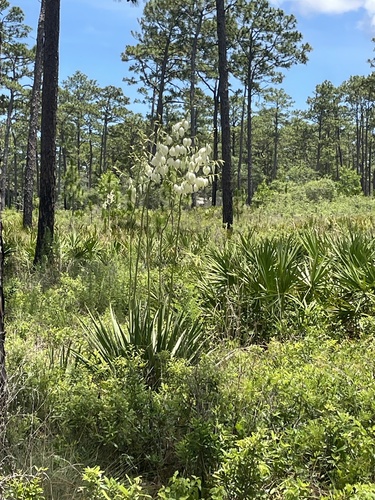
The common yucca is a tall plant with sharp, spiky leaves and beautiful white flowers. It loves sunny places and can grow in dry areas, making it a tough survivor in nature!
Habitat: Desert
The common yucca has stiff, sword-shaped, blue-green leaves often with curly white threads along their edges. A tall, central stalk rises from the rosette, bearing numerous creamy-white, bell-shaped flowers. It stands out with its spiky, architectural form.
Category
PlantsRarity
Common
Danger
2/5 · Low
Snaps
3
Ancient people used yucca roots to make bouncy ropes!
Its flower stalk can grow taller than a basketball hoop!
Some people call it "Adam's Needle" because its leaves are so sharp!
The yucca's special moth babies hatch inside its flowers!
Common yucca has a unique partnership with the yucca moth, which is the only insect that can pollinate its flowers, helping it reproduce.
Yucca can store water in its thick leaves and roots, an adaptation that helps it survive and thrive in very dry places.
Its tough, sharp, pointed leaves create a natural barrier, which helps the yucca defend itself from hungry plant-eaters.
Tegeticula yuccasella
The moth is the only pollinator for yucca flowers.
Tegeticula yuccasella
The moth lays its eggs inside the yucca flowers.
Homo sapiens
Cultivated for ornamental beauty and traditional uses.

Odocoileus virginianus
Deer occasionally browse young yucca shoots.
Aromatic plants produce and emit fragrant volatile organic compounds, often for defense or to attract pollinators.
Flowering plants are any plants that produce flowers as part of their reproductive cycle.
Spring blooming plants produce their flowers during the spring season, often signifying the end of winter and the start of new growth.
Evergreen plants retain their foliage throughout the year, never shedding all their leaves at once.

Drought-tolerant plants can survive and flourish in conditions with limited water availability.

Describes plants that are particularly attractive and beneficial to a wide range of pollinating organisms.

Desert habitats are arid regions characterized by extremely low precipitation and often extreme temperatures, supporting specialized flora and fauna.

This trait characterizes organisms with an exceptionally long lifespan compared to others of their kind.

Possessing sharp, pointed projections or spines on the body or surface.

Describes a species whose presence and role have a disproportionately large effect on its environment.
No aliases listed yet.
Danger
2/5 · Low
Be careful around the sharp leaves; they can poke you!
The easiest way to identify common yucca is to use the Snappit nature identifier app.
60-250 cm
60-90 cm
5-8 cm
Late spring to early summer
Yes
Mild
Perennial
Zoom in to split clusters and explore where this object has been snapped.
Jun 6, 2026
Marineland of FloridaPhoto attribution
(c) Leyla, some rights reserved (CC BY)
License: CC BY 4.0 ↗
Image may be shown cropped inside the card frame.

New York, US
You might spot White Snakeroot, Rock Pigeon, and Eastern Gray Squirrel.
View guide →

Tennessee, US
You might spot Black Maidenhair Fern and Great Blue Heron.
View guide →

Georgia, US
You might spot Monarch, Sandhill Milkweed, and Fiery Skipper.
View guide →

Florida, US
You might spot Bottlenose Dolphin and Loggerhead Sea Turtle.
View guide →
Take the discovery with you
Snap it with Snappit to identify it, learn what makes it special, and add the discovery to your collection.








.jpg&width=800)



_001.jpg&width=800)


