

Crevice Spiny Lizard
sceloporus poinsettii
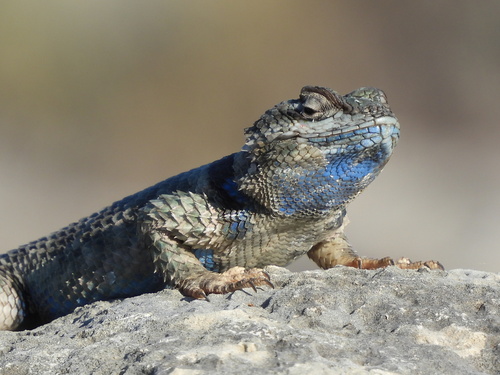
The Crevice Spiny Lizard (Sceloporus poinsettii) is a robust, heavily armored reptile native to the arid rocky environments of the Chihuahuan Desert region, stretching across the southwestern United States and northern Mexico. These highly adapted lizards are famous for their affinity for rocky outcrops, limestone ledges, and deep crevices, where they seek refuge from both predators and the intense desert heat. Renowned for their spiked, overlapping scales and watchful behavior, they are an iconic sight for hikers exploring arid canyons. Unlike many other lizards in their family, Crevice Spiny Lizards are viviparous, giving birth to fully formed live young rather than laying eggs. This unique reproductive strategy, combined with their striking territorial displays and remarkable agility on vertical rock surfaces, makes them one of the most fascinating reptiles of the American desert southwest.
Habitat: Found in arid rocky canyons, limestone cliffs, and boulder piles where deep crevices provide shelter.
This lizard is easily recognized by its stocky build, heavily keeled and pointed scales, and a prominent black-and-white collar around its neck. Its body coloration ranges from olive, grey, to reddish-brown, with dark crossbands running down its back and a tail ringed with distinct black and white bands. Adult males display vibrant blue patches on their throats and the sides of their bellies, which become especially bright during the breeding season. They are relatively large for their genus, typically reaching lengths of 20 to 30 centimeters, including their banded tails.
Category
ReptilesRarity
Common
Danger
1/5 · Very low
Snaps
Be the first to snap!
The species name 'poinsettii' honors Joel Roberts Poinsett, the American diplomat who also introduced the Poinsettia flower to the United States.
To defend their territory, males perform a series of rapid 'push-ups' while flashing their bright blue belly patches to warn off rivals.
Unlike most other spiny lizards which lay eggs, the Crevice Spiny Lizard gives birth to live young (viviparity), an adaptation suited to variable desert environments.
When threatened, this lizard retreats into a rock crack and inflates its body with air, locking its spiny scales against the rock walls to make extraction by predators nearly impossible.
It can voluntarily shed its tail when grabbed by a predator, leaving the wriggling tail behind as a distraction while the lizard escapes.
It utilizes its dark dorsal patterns to quickly absorb solar radiation on cool mornings, rapidly raising its body temperature to optimal hunting levels.
While primarily feeding on a wide variety of terrestrial insects and spiders, adults will occasionally consume soft plant matter such as flowers and tender leaves.
Age differences: Juveniles are strictly insectivorous, focusing on small soft-bodied insects, whereas mature adults occasionally supplement their diet with plant matter.
Eleodes obscurus
Preys heavily on this abundant desert beetle.

Geococcyx californianus
Routinely preys upon the lizard, pulling it from crevices or catching it while basking.

Urosaurus ornatus
Competes for basking sites, crevice shelters, and insect prey.
No trait badges are assigned for this object yet.
No aliases listed yet.
Collections for this object will appear here as more themes are added.
Danger
1/5 · Very low
No special safety notes yet.
Compare toes, scales, head shape, crests and tail proportions. Many lizards can drop and regrow their tails, so a short tail isn't always a species trait. Lizard Identifier: upload a photo and compare the visible details.
20-30 cm
0.04-0.12 kg
5-10 years
15 km/h
While primarily feeding on a wide variety of terrestrial insects and spiders, adults will occasionally consume soft plant matter such as flowers and tender leaves.
Found in arid rocky canyons, limestone cliffs, and boulder piles where deep crevices provide shelter.
Ambush
Zoom in to split clusters and explore where this object has been snapped.
Recent snaps will appear here as new observations are added.
Take the discovery with you
Snap it with Snappit to identify it, learn what makes it special, and add the discovery to your collection.