.jpg&width=800)





cypress spurge
Euphorbia cyparissias
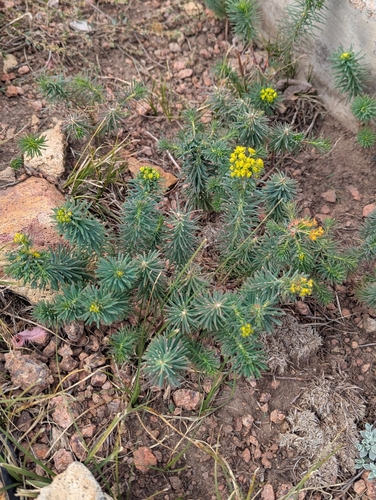
Cypress spurge is a bright green plant with small yellow flowers. It grows in sunny places and can spread quickly, making it a lively part of the garden!
Habitat: Grasslands
The cypress spurge has upright stems covered in dense, narrow, blue-green leaves resembling cypress needles. Its true flowers are tiny, surrounded by striking chartreuse to bright yellow-green bracts, creating a vibrant display.
Category
PlantsRarity
Common
Danger
2/5 · Low
Snaps
8
Believe it or not, this plant is a cousin to the festive Christmas poinsettia!
Its milky sap was once used as a folk remedy for removing warts!
The 'cypress' in its name comes from its needle-like leaves, just like a tiny evergreen!
This plant can spread super fast, taking over sunny spots and fields!
Cypress spurge has a milky, latex sap that oozes out when broken, protecting it from hungry herbivores.
Cypress spurge can spread rapidly using tough underground stems called rhizomes, helping it colonize new ground.
Cypress spurge has bright yellow-green bracts that attract bees and other insects to its small, inconspicuous flowers.
Aphthona cyparissiae
Feeds on the roots and foliage, used for biocontrol.
Apis mellifera
Visits flowers for nectar and pollen.
Bombus impatiens
Collects nectar and pollen from its blooms.
Flowering plants are any plants that produce flowers as part of their reproductive cycle.
Spring blooming plants produce their flowers during the spring season, often signifying the end of winter and the start of new growth.
Evergreen plants retain their foliage throughout the year, never shedding all their leaves at once.
Medicinal plants possess chemical compounds that can be used for therapeutic purposes to treat illnesses or maintain health.

Drought-tolerant plants can survive and flourish in conditions with limited water availability.

Grassland habitats are terrestrial biomes dominated by grasses and herbaceous plants, supporting a variety of grazing animals.

Describes plants that are particularly attractive and beneficial to a wide range of pollinating organisms.

Rapid growing plants exhibit accelerated growth rates, quickly increasing in size and biomass within a short period.
No aliases listed yet.
Danger
2/5 · Low
Be careful not to touch the milky sap, as it can irritate your skin.
The easiest way to identify cypress spurge is to use the Snappit nature identifier app.
10-40 cm
Spring to early summer
No
Moderate
Perennial
Insect
Grasslands
Zoom in to split clusters and explore where this object has been snapped.
Sep 21, 2025
Cripple Creek Historic DistrictPhoto attribution
(c) Eric Watts, some rights reserved (CC BY)
License: CC BY 4.0 ↗
Image may be shown cropped inside the card frame.

New York, US
You might spot Garter Snake, Painted Turtle, and Monarch.
View guide →

Wyoming, US
You might spot Moose, Uinta Ground Squirrel, and American Bison.
View guide →

Connecticut, US
You might spot Asian Lady Beetle and Baltimore Snout.
View guide →

New Jersey, US
You might spot Rock Harlequin, Pink Lady's Slipper, and Eastern Hemlock.
View guide →

Wyoming, US
You might spot Moose, Uinta Ground Squirrel, and American Bison.
View guide →

Colorado, US
You might spot Great Basin Bristlecone Pine and Mule Deer.
View guide →
Take the discovery with you
Snap it with Snappit to identify it, learn what makes it special, and add the discovery to your collection.








.jpg&width=800)



_001.jpg&width=800)



