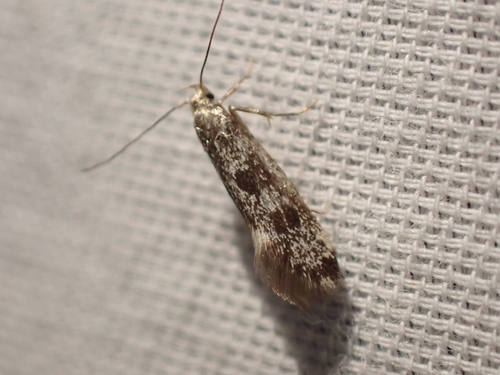





Denisia haydenella
Denisia haydenella
Denisia haydenella is a small, colorful moth that loves to flutter around flowers. It has beautiful patterns on its wings that can be spotted in gardens and meadows.
Habitat: Meadows
The Denisia haydenella is a small moth with a somewhat flattened body. Its forewings are mottled in shades of yellowish-brown and darker brown, often with subtle purplish hints, while the hindwings are paler gray. It has a distinctive, broad head relative to its body.
Category
InsectsRarity
Common
Danger
1/5 · Very low
Snaps
Be the first to snap!
Its caterpillars munch on dead leaves and fungi, being nature's tiny decomposers!
Some moths in its family can have a purplish sheen on their wings!
This moth's flattened body lets it squeeze into tiny cracks to hide!
When resting, it folds its wings tightly, looking just like a broken twig!
Denisia haydenella larvae can blend into leaf litter because they feed and live among decaying plant material, which helps them hide from predators.
Denisia haydenella has a slightly flattened body shape that helps it squeeze into tight crevices, providing shelter and camouflage.
Denisia haydenella can attract mates from a distance by releasing special chemical scents called pheromones, helping them find each other.
Denisia haydenella can navigate and find food in the dark because it has excellent night vision and senses for detecting nectar.
Adult Denisia haydenella sips nectar, while its larvae are nature's tiny decomposers!
Age differences: Larvae feed on dead leaves, decaying wood, and fungi, while adult moths drink nectar from flowers.

Quercus alba
Larvae feed on its decaying leaves.

Acer rubrum
Provides decaying leaves for larvae.

Myotis lucifugus
Nocturnal adults are prey.

Erigeron annuus
Adults drink nectar from its flowers.
Trametes versicolor
Larvae may consume this fungus.
Marked with spots or patches of a different color.
Aerial creatures spend a significant portion of their lives airborne, utilizing flight for various activities such as hunting, migration, or nesting.
Colorful describes organisms or objects displaying a wide range of bright and distinct colors.
Grassland habitats are terrestrial biomes dominated by grasses and herbaceous plants, supporting a variety of grazing animals.
This trait characterizes organisms whose diet consists entirely or primarily of plant material.
Describes plants that are particularly attractive and beneficial to a wide range of pollinating organisms.
Diurnal animals are primarily active during daylight hours, typically resting or sleeping at night.
Describes organisms that transfer pollen, enabling the fertilization and reproduction of plants.
No aliases listed yet.
Danger
1/5 · Very low
Moths are gentle creatures, but it's best to watch them from a distance.
Compare resting wing shape, forewing markings, antennae and body build. Small brown moths can hinge on fine details a phone photo can't always catch. Moth Identifier: upload a photo and compare the visible details.
15-25 mm
8-12 mm
7-14 days
8 km/h
Adult Denisia haydenella sips nectar, while its larvae are nature's tiny decomposers!
Meadows
Foraging
Zoom in to split clusters and explore where this object has been snapped.
Recent snaps will appear here as new observations are added.
Take the discovery with you
Snap it with Snappit to identify it, learn what makes it special, and add the discovery to your collection.