





Desert Prince's Plume
Stanleya pinnata
The Desert Prince's Plume is a tall, beautiful plant with bright yellow flowers. It grows in dry, sandy places and can survive with very little water, making it special in the desert!
Habitat: Desert
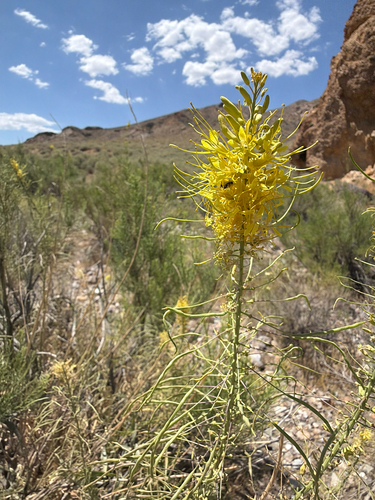
The Desert Prince's Plume has striking, tall spikes of bright yellow flowers that resemble a royal feather, emerging from a base of silvery-green, deeply lobed leaves. Its unique plume-like clusters stand out against the muted desert landscape.
Category
PlantsRarity
Common
Danger
1/5 · Very low
Snaps
15
It's sometimes called 'Desert Spectacle Pod' for its distinctive seed pods!
Its tough seeds can stay dormant for many, many years, waiting for rain!
The 'plume' is actually a dense cluster of many, many small yellow flowers!
This desert beauty is a wild cousin of your broccoli and cabbage!
Desert Prince's Plume has a powerful taproot that can reach deep into the soil to find precious water in dry desert conditions.
This plant can tolerate salty soils because it has special ways to store or remove excess salt, letting it grow where others can't.
Its leaves often have a waxy, grayish coating that helps reflect intense sunlight, keeping the plant cool and reducing water loss.
Apis mellifera
Collects nectar and pollen from flowers.
Bombus vosnesenskii
Feeds on abundant yellow flowers for nectar.
Xylocopa sonorina
Visits the vibrant plumes for sustenance.
Flowering plants are any plants that produce flowers as part of their reproductive cycle.
Summer blooming plants produce their flowers during the summer season, often providing vibrant color when many other plants have finished.
Medicinal plants possess chemical compounds that can be used for therapeutic purposes to treat illnesses or maintain health.
Drought-tolerant plants can survive and flourish in conditions with limited water availability.

Colorful describes organisms or objects displaying a wide range of bright and distinct colors.

Describes plants that are particularly attractive and beneficial to a wide range of pollinating organisms.

Desert habitats are arid regions characterized by extremely low precipitation and often extreme temperatures, supporting specialized flora and fauna.

Describes a species whose presence and role have a disproportionately large effect on its environment.
No aliases listed yet.
Danger
1/5 · Very low
Always look but don't touch plants in the wild, as some may not be safe.
The easiest way to identify Desert Prince's Plume is to use the Snappit nature identifier app.
30-90 cm
20-40 cm
1.2-2.5 cm
Spring to early summer
No
Moderate
Perennial
Zoom in to split clusters and explore where this object has been snapped.
May 25, 2026
SkidooPhoto attribution
(c) Aaron Liston, some rights reserved (CC BY)
License: CC BY 4.0 ↗
Image may be shown cropped inside the card frame.

Colorado, US
You might spot Common Side-Blotched Lizard and Eastern Collared Lizard.
View guide →

Kansas, US
You might spot Cliff Swallow and Desert Prince's Plume.
View guide →

California, US
You might spot Desert Holly, Western Joshua Tree, and Creosote Bush.
View guide →

California, US
You might spot Frémont's Phacelia and Devil's Spineflower.
View guide →

New Mexico, US
You might spot Common Side-Blotched Lizard and Kingcup Cactus.
View guide →

Colorado, US
You might spot African Penguin, Red Panda, and African Lion.
View guide →
Take the discovery with you
Snap it with Snappit to identify it, learn what makes it special, and add the discovery to your collection.








.jpg&width=800)



_001.jpg&width=800)




