
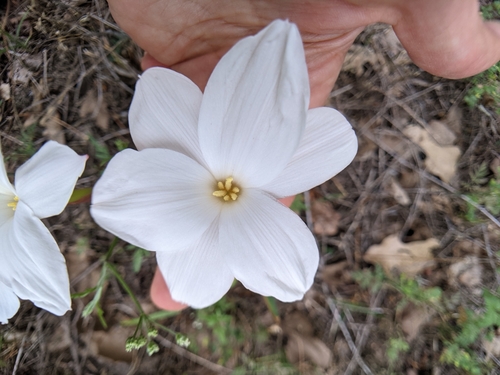


Drummond'S Rain Lily
zephyranthes drummondii
Drummond'S Rain Lily, also known as the giant rain lily or evening star, is an enchanting perennial wildflower native to the sandy prairies and rocky limestone hills of Texas, New Mexico, and Mexico. This remarkable plant is famous for its sudden, dramatic emergence. For most of the year, it remains completely dormant underground, but within two to three days after a heavy summer or autumn rain, it sends up elegant stalks topped with large, fragrant blossoms. This rapid post-rain flush creates breathtaking, fleeting spectacles where fields are transformed into carpets of white virtually overnight.
Habitat: Found in dry, calcareous prairies, open pastures, sandy fields, and rocky limestone hillsides, often thriving in areas that experience seasonal dry spells followed by sudden heavy rains.
This plant produces a solitary, upright flower stem reaching 15 to 45 centimeters in height, carrying a single funnel-shaped blossom that opens up to 7 centimeters across. The six tepals are pristine white upon opening but gently fade to a delicate, dusty pink as they age. From the base, a few narrow, flattened, grayish-green grass-like leaves emerge, though they are often absent or minimal during the initial bloom. The flower is especially distinct in the evening when it opens fully to release its sweet, soapy fragrance.
Category
PlantsRarity
Common
Danger
1/5 · Very low
Snaps
Be the first to snap!
Despite its beauty, the entire plant is poisonous; its bulbs contain alkaloids that can cause severe gastrointestinal distress if ingested by pets or humans.
The generic name Zephyranthes translates to 'flower of the west wind', referencing its native occurrence in the Western Hemisphere.
The rapid growth of the flower stalk and blooming mechanism is called 'flushing', a survival tactic to take quick advantage of temporary water in arid environments.
This plant is sometimes referred to as the 'evening star' because, unlike other rain lilies that bloom in the morning, its flowers typically open late in the afternoon or at dusk.
The bulb can sense the sudden pressure and moisture change of heavy rainfall, initiating rapid growth to bloom within 48 to 72 hours.
It releases a potent, sweet scent specifically at dusk and throughout the night to attract nocturnal pollinators like hawk moths.
The underground bulb contains toxic lycorine and other phenanthridine alkaloids that deter burrowing rodents and insects.
As a photosynthetic plant, it manufactures its own chemical energy from sunlight, water, and carbon dioxide, while absorbing essential minerals through its subterranean root system.
Hyles lineata
The evening star rain lily relies on the pollination services of nocturnal hawk moths, such as the White-lined Sphinx, which are attracted to its strong evening scent and white petals.

Odocoileus virginianus
Foliage and seed pods of the rain lily are sometimes grazed by mammals like the White-tailed Deer, despite the inherent toxicity of its bulbs.

Apis mellifera
Attracted to the pollen and early morning nectar of newly opened blooms, honeybees help with secondary daytime pollination.
No trait badges are assigned for this object yet.
No aliases listed yet.
Collections for this object will appear here as more themes are added.
Danger
1/5 · Very low
No special safety notes yet.
Start with the whole plant, then compare leaf arrangement, leaf edges, stems and any flowers or fruit. Opposite leaves grow in pairs; alternate leaves come one at a time along the stem. These details tell you far more together than a single green leaf does. Plant Identifier: upload a photo and compare the visible details.
As a photosynthetic plant, it manufactures its own chemical energy from sunlight, water, and carbon dioxide, while absorbing essential minerals through its subterranean root system.
Found in dry, calcareous prairies, open pastures, sandy fields, and rocky limestone hillsides, often thriving in areas that experience seasonal dry spells followed by sudden heavy rains.
Zoom in to split clusters and explore where this object has been snapped.
Recent snaps will appear here as new observations are added.
Take the discovery with you
Snap it with Snappit to identify it, learn what makes it special, and add the discovery to your collection.



















