%2C_mating.jpg&width=800)





Eastern Lubber Grasshopper
Romalea microptera
The Eastern Lubber Grasshopper is a big, colorful insect that loves to hop around in gardens and fields. With its bright colors, it can be hard to miss!
Habitat: Grasslands
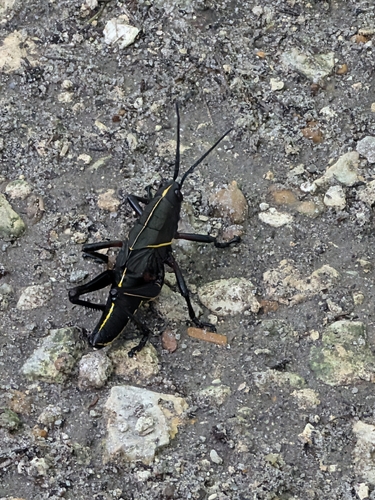
The Eastern Lubber Grasshopper is a very large insect with a bright yellow body, often adorned with black markings and sometimes red or orange on its head and legs. Its most striking feature is its short, leathery wings that are too small for flight, contrasting with its robust body.
Category
InsectsRarity
Common
Danger
1/5 · Very low
Snaps
40
Lubber grasshoppers often lay their eggs safely underground, where they spend the entire winter.
Their name 'lubber' means clumsy, which fits how they slowly walk instead of fly!
These bold insects can squirt a stinky, bubbly liquid from their bodies when they feel scared!
They munch on some plants that are poisonous to other animals, making the grasshoppers toxic too!
Eastern Lubber Grasshopper can secrete a foul-smelling, toxic foam because it eats poisonous plants, which helps them deter predators.
Eastern Lubber Grasshopper has bright yellow and black patterns that serve as a clear warning sign, helping them tell predators they are toxic.
Eastern Lubber Grasshopper can use its strong hind legs to make impressive jumps, which helps them escape danger quickly on the ground.
These brightly colored grasshoppers munch on a variety of plants, making them herbivores.
Solitary animals live alone for most of their lives, only interacting with others for mating or parental care.
Colorful describes organisms or objects displaying a wide range of bright and distinct colors.
Grassland habitats are terrestrial biomes dominated by grasses and herbaceous plants, supporting a variety of grazing animals.
This trait characterizes organisms whose diet consists entirely or primarily of plant material.

Diurnal animals are primarily active during daylight hours, typically resting or sleeping at night.

Giant describes organisms or objects of significantly larger size than average for their species or type.

Describes organisms that transfer pollen, enabling the fertilization and reproduction of plants.
No aliases listed yet.
Danger
1/5 · Very low
Don't touch grasshoppers, as some can be a bit spicy if you try to eat them!
The easiest way to identify Eastern Lubber Grasshopper is to use the Snappit nature identifier app.
30-70 mm
180-270 days
These brightly colored grasshoppers munch on a variety of plants, making them herbivores.
Grasslands
Grazing
6
Zoom in to split clusters and explore where this object has been snapped.
May 24, 2026
Silver SpringsPhoto attribution
no rights reserved
License: CC0 1.0 ↗
Image may be shown cropped inside the card frame.

Alabama, US
You might spot Elf Orpine, Canada Goose, and Leatherleaf Mahonia.
View guide →

Georgia, US
You might spot Common Vetch, Tiny Bluet, and Carolina Crane's-Bill.
View guide →

Georgia, US
You might spot Gulf Fritillary, Anole, and American Beautyberry.
View guide →

Alabama, US
You might spot American Beautyberry, White-Tailed Deer, and Peppervine.
View guide →

Alabama, US
You might spot Anole, Eastern Box Turtle, and Resurrection Fern.
View guide →

Florida, US
You might spot American Alligator, Brown Anole, and Red-Shouldered Hawk.
View guide →
Take the discovery with you
Snap it with Snappit to identify it, learn what makes it special, and add the discovery to your collection.








.jpg&width=800)



