





Eastern Tailed-Blue
Cupido comyntas
The Eastern Tailed-Blue is a small butterfly with beautiful blue wings. It loves to flutter around flowers and is often seen in gardens and fields.
Habitat: Grasslands
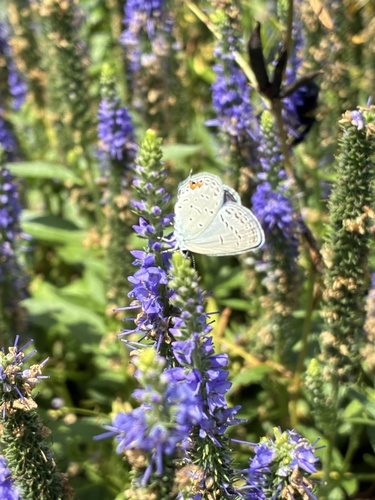
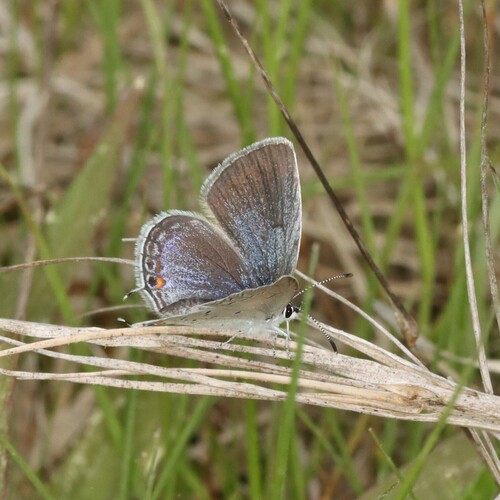
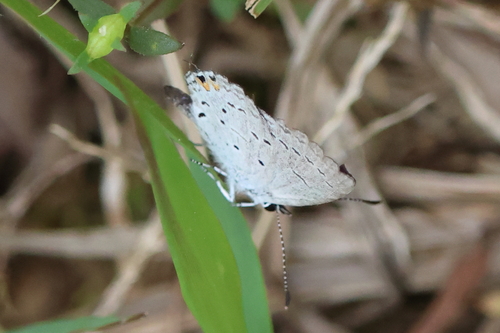
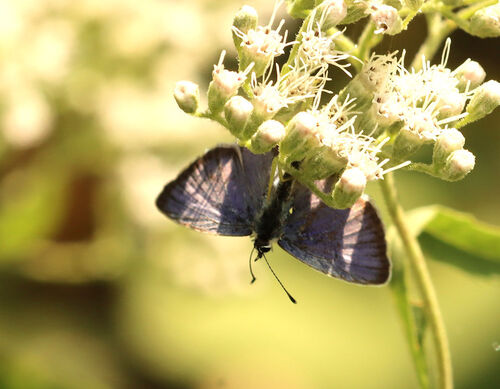
The Eastern Tailed-Blue has iridescent blue upper wings in males, while females are duller blue or brownish-grey. Both sexes feature two small black spots and delicate, thread-like 'tails' near the hindwing margin, often edged with orange.
Category
InsectsRarity
Common
Danger
1/5 · Very low
Snaps
45
Male Eastern Tailed-Blues often 'puddle' together, drinking minerals from damp ground!
Some Eastern Tailed-Blue caterpillars secrete a sugary fluid that ants love to drink!
Their tiny, ridged eggs are often laid one by one on the tender young leaves of host plants.
These butterflies are 'generalists' and can thrive in many different habitats, even bustling cities!
Eastern Tailed-Blue has tiny 'tails' and eye-spots that mimic a head, making predators strike the wrong end, allowing for escape.
Its caterpillars can be green or brown and have a bumpy texture, helping them perfectly blend with their host plants to hide.
The butterfly has a long, straw-like proboscis that helps it reach deep into flowers to slurp up sweet nectar.
Adults sip flower nectar; caterpillars munch on legume leaves.
Age differences: Larvae (caterpillars) feed on plant leaves and flowers; adults feed on nectar from various flowering plants.

Trifolium repens
Adults visit for nectar.
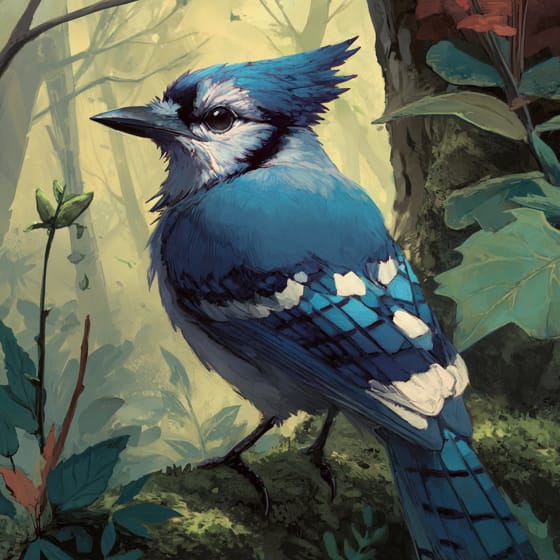
Cyanocitta cristata
A common bird predator.

Medicago sativa
Larvae feed on leaves.
Misumena vatia
Ambush predator on flowers.
Colorful describes organisms or objects displaying a wide range of bright and distinct colors.
Grassland habitats are terrestrial biomes dominated by grasses and herbaceous plants, supporting a variety of grazing animals.
This trait characterizes organisms whose diet consists entirely or primarily of plant material.
Describes plants that are particularly attractive and beneficial to a wide range of pollinating organisms.

Diurnal animals are primarily active during daylight hours, typically resting or sleeping at night.

This trait identifies organisms that exhibit exceptional swiftness in movement for hunting, escape, or travel.

Describes organisms that transfer pollen, enabling the fertilization and reproduction of plants.
No aliases listed yet.
Danger
1/5 · Very low
Butterflies are gentle and safe to watch. Be quiet and still to see them better!
The easiest way to identify Eastern Tailed-Blue is to use the Snappit nature identifier app.
25-35 mm
20-30 mm
10-20 days
Adults sip flower nectar; caterpillars munch on legume leaves.
Grasslands
Foraging
6
Zoom in to split clusters and explore where this object has been snapped.
Jun 5, 2026
Bernheim Forest and ArboretumPhoto attribution
(c) Anne H. Proffitt, some rights reserved (CC BY)
License: CC BY 4.0 ↗
Image may be shown cropped inside the card frame.
May 29, 2026
Lowell Holly ReservationPhoto attribution
(c) Jake McCumber, some rights reserved (CC BY)
License: CC BY 4.0 ↗
Image may be shown cropped inside the card frame.
Apr 26, 2026
Scottsville Historic DistrictPhoto attribution
(c) Andre Knocklein, some rights reserved (CC BY)
License: CC BY 4.0 ↗
Image may be shown cropped inside the card frame.
Sep 9, 2025
Marked Tree Lock and SiphonsPhoto attribution
(c) hr_dragonfly, some rights reserved (CC BY)
License: CC BY 4.0 ↗
Image may be shown cropped inside the card frame.

Michigan, US
You might spot Eastern Gray Squirrel, Tree-Of-Heaven, and House Sparrow.
View guide →

Maryland, US
You might spot Crane-Fly Orchid, Fragile Forktail, and Ebony Jewelwing.
View guide →

Arkansas, US
You might spot Widow's-Cross, Yucca Giant-Skipper, and Outis Skipper.
View guide →
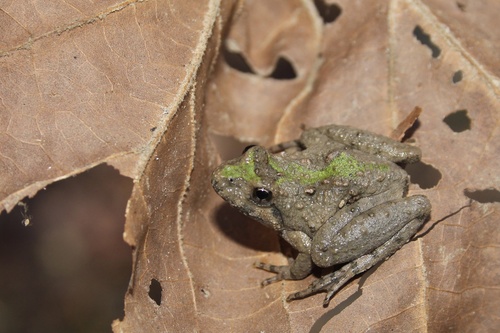
Maryland, US
You might spot Northern Cricket Frog and Common Whitetail.
View guide →

Maryland, US
You might spot Osprey, Duck, and Spotted Lanternfly.
View guide →

Ohio, US
You might spot Blue-Fronted Dancer, American Rubyspot, and Fowler's Toad.
View guide →
Take the discovery with you
Snap it with Snappit to identify it, learn what makes it special, and add the discovery to your collection.






.jpg&width=800)



