





False Nettle
boehmeria cylindrica
False Nettle is a tall, green plant that likes to grow near rivers and in wet areas. Its leaves are soft and fuzzy, making it a comfy home for little critters!
Habitat: False Nettle typically grows in moist soil near rivers, streams, and wetlands.
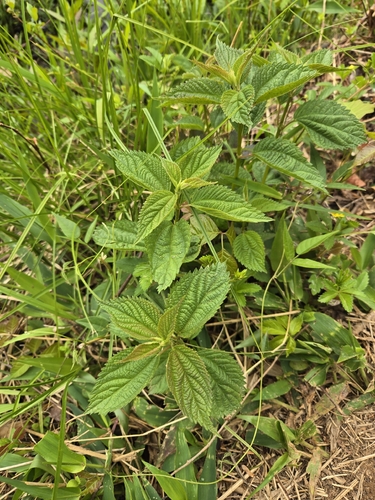
The False Nettle has rough, deep green leaves with toothed edges, resembling stinging nettles but lacking their painful sting. Its slender, often reddish stems bear tiny, greenish-white flowers clustered in spikes, making them quite inconspicuous.
Category
PlantsRarity
Common
Danger
0/5 · No known danger
Snaps
5
Ancient cultures used its strong stem fibers for weaving cloth and rope!
Despite its name, you can safely touch this plant; it won't sting you!
Find it lurking in shady, damp spots, especially along forest edges!
Its tiny leaves are surprisingly edible when cooked, like spinach!
False Nettle has soft, harmless hairs on its leaves, making it a convincing lookalike for stinging nettles without the painful sting.
False Nettle can thrive in shady, damp environments, allowing it to grow where many other plants struggle to find light.
False Nettle possesses tough stem fibers, historically used by people to weave strong ropes and durable fabrics.
Polygonia interrogationis
Caterpillars feed on its leaves.

Odocoileus virginianus
Deer browse on its foliage.
Apis mellifera
Bees visit its small flowers for nectar.
Vanessa atalanta
Caterpillars also consume its leaves.
Social animals live in organized groups, cooperating for survival benefits such as foraging, defense, and raising offspring.
Colorful describes organisms or objects displaying a wide range of bright and distinct colors.
This trait characterizes organisms whose diet consists entirely or primarily of plant material.
Forest habitats are terrestrial environments dominated by dense tree cover, supporting a high diversity of plant and animal life.

Aquatic habitats encompass environments where organisms live predominantly in water, including oceans, rivers, lakes, and wetlands.
Danger
0/5 · No known danger
No special safety notes yet.
The easiest way to identify False Nettle is to use the Snappit nature identifier app.
30-120 cm
30-60 cm
0.1-0.3 cm
Late summer to early fall
Yes
None
Perennial
Zoom in to split clusters and explore where this object has been snapped.
Apr 26, 2026
Scottsville Historic DistrictPhoto attribution
(c) Andre Knocklein, some rights reserved (CC BY)
License: CC BY 4.0 ↗
Image may be shown cropped inside the card frame.

Alabama, US
You might spot Anole, Eastern Gray Squirrel, and Asian Lady Beetle.
View guide →

Alabama, US
You might spot Anole, Eastern Gray Squirrel, and Asian Lady Beetle.
View guide →

Alabama, US
You might spot Anole, Eastern Gray Squirrel, and Asian Lady Beetle.
View guide →
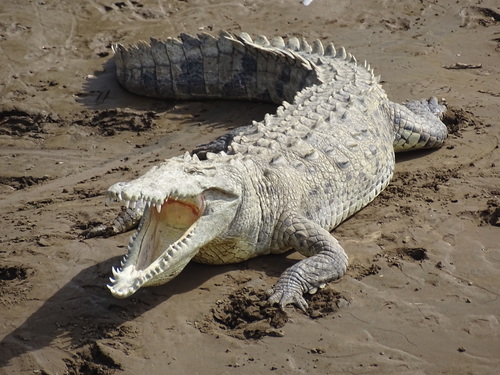
Florida, US
You might spot American Crocodile and American Alligator.
View guide →

Ohio, US
You might spot Canada Goose and Common Eastern Bumble Bee.
View guide →

Indiana, US
You might spot Painted Turtle and Virginia Springbeauty.
View guide →
Take the discovery with you
Snap it with Snappit to identify it, learn what makes it special, and add the discovery to your collection.








.jpg&width=800)



_001.jpg&width=800)




