





Fee's lip fern
Myriopteris gracilis
Fee's lip fern is a delicate plant with beautiful, wavy leaves. It loves to grow in shady spots and can be found in rocky areas. This fern is special because it can survive in dry places where other plants might not.
Habitat: Rocky areas
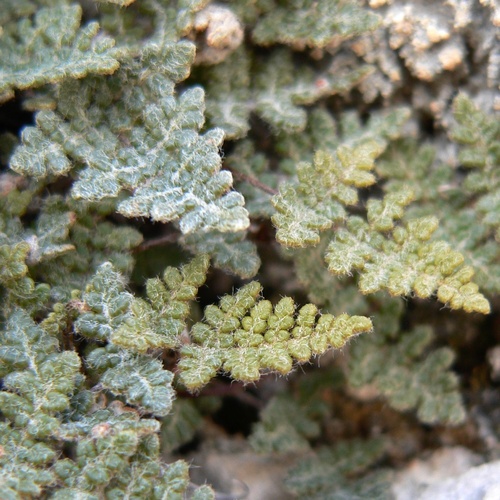
The Fee's lip fern has small, delicate fronds that are often silvery-green or gray-green. Its fronds are deeply cut, giving them a lacy appearance, and they often have fine hairs on their undersides, making it visually distinct from many smooth ferns.
Category
PlantsRarity
Common
Danger
1/5 · Very low
Snaps
5
Ferns like this one are ancient plants, appearing on Earth long before flowers!
Instead of seeds, Fee's lip fern reproduces using tiny, dust-like spores.
Its 'lip' name refers to the tiny shield-like covers over its spores!
This hardy fern can survive in very dry, sunny spots where few other ferns can live.
Fee's lip fern can curl its fronds tightly when dry, protecting itself from water loss and bouncing back when rain returns.
Fee's lip fern has tough, fibrous rhizomes that help it anchor firmly in tiny cracks of rocky cliffs and ledges.
Rhizophagus irregularis
fungi help its roots absorb vital soil nutrients.
Deroceras reticulatum
slugs may occasionally graze on its fronds.
Bacillus subtilis
relies on various soil bacteria for nutrient cycling.
This trait characterizes plants lacking specialized vascular tissues (xylem and phloem) for transporting water and nutrients.
Ornamental plants are cultivated primarily for their aesthetic appeal, enhancing landscapes and gardens with their attractive foliage, flowers, or form.
Grass-like plants are herbaceous plants that visually resemble true grasses, typically having long, narrow leaves.
Shade tolerant plants are adapted to grow and thrive in areas with low light levels, requiring less direct sunlight.

Evergreen plants retain their foliage throughout the year, never shedding all their leaves at once.

Drought-tolerant plants can survive and flourish in conditions with limited water availability.
No aliases listed yet.
Danger
1/5 · Very low
Always look but don't touch plants unless you know they are safe.
The easiest way to identify Fee's lip fern is to use the Snappit nature identifier app.
5-20 cm
10-30 cm
No
None
Perennial
Rocky areas
Zoom in to split clusters and explore where this object has been snapped.
Feb 18, 2007
Red Rock Canyon National Conservation AreaPhoto attribution
(c) Stan Shebs, some rights reserved (CC BY-SA)
License: CC BY-SA 4.0 ↗
Image may be shown cropped inside the card frame.

Wisconsin, US
You might spot Eastern Redcedar, Rock Polypody, and Vulture.
View guide →

Nevada, US
You might spot Engelmann's Hedgehog Cactus.
View guide →

Utah, US
You might spot Roundleaf Buffaloberry, Mule Deer, and Kingcup Cactus.
View guide →

Illinois, US
You might spot Virginia Bluebells and Wavy-Lined Emerald.
View guide →

Arizona, US
You might spot Fernbush, Mat Rock Spiraea, and Baker Kingcup Cactus.
View guide →
South Dakota, US
You might spot Bighorn Sheep and Narrow-Leaved Purple Coneflower.
View guide →
Take the discovery with you
Snap it with Snappit to identify it, learn what makes it special, and add the discovery to your collection.









.jpg&width=800)



_001.jpg&width=800)


