





Four-lined Plant Bug
Poecilocapsus lineatus
The Four-lined Plant Bug is a small insect with four distinct lines on its back. It loves to munch on plants and can be found in gardens and fields. These bugs are colorful and fun to spot!
Habitat: Urban areas, Gardens
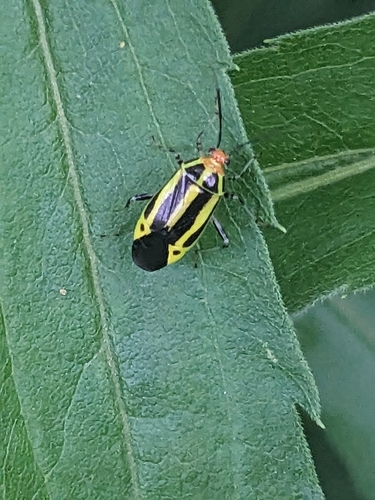
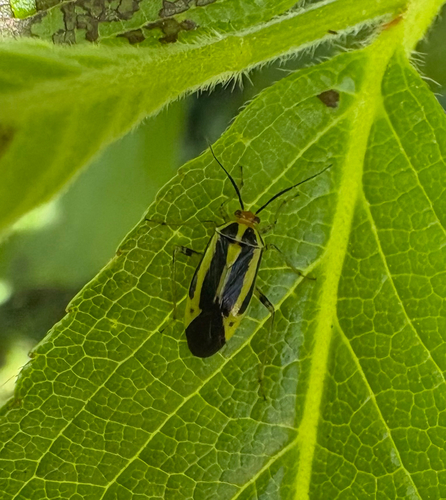
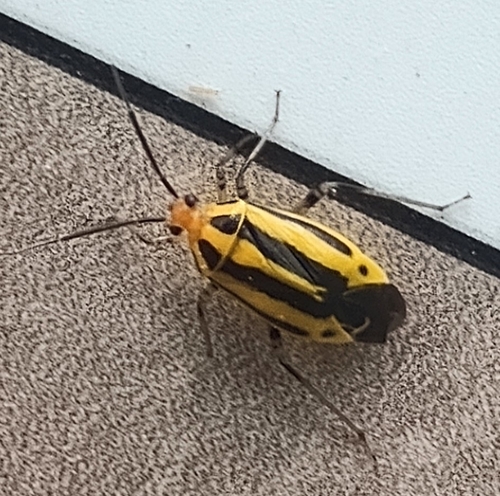
The Four-lined Plant Bug has a bright yellowish-green body with four distinct black stripes running lengthwise down its back. Its head is also black, contrasting sharply with its vibrant body, and it possesses long, dark antennae. This vivid coloration makes it stand out on lighter leaves.
Category
InsectsRarity
Common
Danger
1/5 · Very low
Snaps
36
An adult Four-lined Plant Bug typically lives for just three to four weeks!
Female Four-lined Plant Bugs lay their eggs deep inside woody plant stems to overwinter!
Their nymphs, or young bugs, are surprisingly bright red with striking black spots!
These bugs cause distinctive round, dark spots on plant leaves where they feed!
Four-lined Plant Bug can pierce plant tissues because of its straw-like mouthparts that help them drink nutrient-rich sap.
Four-lined Plant Bug can quickly drop from plants or fly away because of its agility that helps them escape predators swiftly.
Four-lined Plant Bug has a bright green body that helps them blend perfectly with plant foliage, making them hard to spot.
This bug sips nutrient-rich juices from many types of garden and wild plants.
Mentha spicata
Feeds on sap, causing leaf damage.

Syringa vulgaris
Pierces leaves to extract plant juices.

Cornus florida
Sap feeding can distort new growth.
Podisus maculiventris
A generalist predator of soft-bodied insects.
Orius insidiosus
Known to prey on their eggs and nymphs.
Marked with parallel bands or lines of color.
Solitary animals live alone for most of their lives, only interacting with others for mating or parental care.
Camouflaged describes organisms that possess coloring or patterns that allow them to blend into their environment.
Colorful describes organisms or objects displaying a wide range of bright and distinct colors.

This trait characterizes organisms whose diet consists entirely or primarily of plant material.

Diurnal animals are primarily active during daylight hours, typically resting or sleeping at night.

Describes a species whose presence and role have a disproportionately large effect on its environment.

This habitat trait indicates species that can coexist with humans in urban and suburban environments, utilizing man-made structures and green spaces.

Describes organisms that transfer pollen, enabling the fertilization and reproduction of plants.
No aliases listed yet.
Danger
1/5 · Very low
These bugs are harmless, but it's best to look and not touch them.
The easiest way to identify Four-lined Plant Bug is to use the Snappit nature identifier app.
7-8 mm
20-30 days
This bug sips nutrient-rich juices from many types of garden and wild plants.
Urban areas, Gardens
Foraging
6
Zoom in to split clusters and explore where this object has been snapped.
Jun 5, 2026
SEA LIFE Minnesota AquariumPhoto attribution
(c) tyler bailey, some rights reserved (CC BY)
License: CC BY 4.0 ↗
Image may be shown cropped inside the card frame.
Jun 5, 2026
Bedford Village Historic DistrictPhoto attribution
(c) eml23, some rights reserved (CC BY)
License: CC BY 4.0 ↗
Image may be shown cropped inside the card frame.
May 1, 2026
Columbia CanalPhoto attribution
(c) Raven Dandridge, some rights reserved (CC BY)
License: CC BY 4.0 ↗
Image may be shown cropped inside the card frame.

Rhode Island, US
You might spot Common Eastern Bumble Bee and Osprey.
View guide →

South Carolina, US
You might spot Great Blue Heron, Spanish Moss, and Cahaba Lily.
View guide →

New Jersey, US
You might spot American Beech, Garlic Mustard, and Spotted Lanternfly.
View guide →

Wisconsin, US
You might spot Common Eastern Bumble Bee, Monarch, and Bee.
View guide →
Pennsylvania, US
You might spot White-Tailed Deer, Eastern Bluebird, and Northern Cardinal.
View guide →

Wisconsin, US
You might spot American Cancer-Root and Eastern White Pine.
View guide →
Take the discovery with you
Snap it with Snappit to identify it, learn what makes it special, and add the discovery to your collection.







.jpg&width=800)


