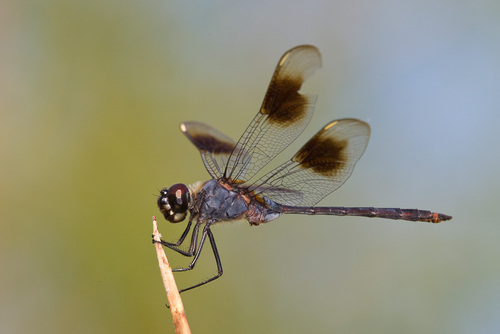


Four-Spotted Pennant
brachymesia gravida
The Four-Spotted Pennant (Brachymesia gravida) is a striking and highly active dragonfly commonly found darting over brackish coastal marshes, ponds, and slow-moving streams. Renowned for its distinctive perching style, this dragonfly often clings to the very tips of tall marsh grasses, swaying in the breeze like a tiny colorful flag or 'pennant'. This behavior, combined with its bold aerial maneuvers, makes it a favorite among insect watchers and nature enthusiasts. As voracious predators of smaller flying insects, they serve a vital ecological role in regulating pest populations. Their complex life cycle, transitioning from aquatic nymphs to master aerial acrobats, highlights the fascinating adaptability of the Odonata order.
Habitat: Typically found in brackish coastal marshes, estuarine wetlands, and sluggish freshwater ponds or lakes with abundant emergent vegetation.
This medium-to-large dragonfly features a robust body length of around 5 centimeters and a wingspan of up to 9 centimeters. Mature adult males develop a chalky, pale blue-gray pruinescence over their abdomens, while females and young males exhibit a warm yellowish-brown color patterned with dark, jagged dorsal markings. Their wings are mostly clear but are instantly recognizable by four prominent, dark brown spots situated at the midpoint (nodus) of each wing, as well as dark brown stigmas near the tips and amber-tinted washes at the wing bases.
Category
InsectsRarity
Common
Danger
1/5 · Very low
Snaps
2
As nymphs, they are formidable underwater predators, possessing a unique, extendable lower lip (labium) that shoots out to grab prey in a fraction of a second.
During intense midday heat, they can prevent overheating by raising their abdomens vertically in a behavior called the 'obelisk posture' to minimize sun exposure.
The name 'pennant' comes from their unique habit of perching at the tips of tall vegetation, where they flutter in the breeze like tiny flags.
While they tolerate freshwater, they are highly adapted to brackish water environments, which is relatively rare among North American dragonfly species.
They use exceptionally strong tarsal claws to securely grip the tips of swaying reeds, allowing them to remain stable and scan for prey even in high-wind coastal environments.
Equipped with massive compound eyes containing nearly 30,000 ommatidia, they can detect the slightest motion in almost any direction, making them highly efficient hunters.
They can control each of their four wings independently, enabling them to hover, fly backward, and change direction instantly to intercept fast-flying insect prey.
Feeds almost exclusively on flying insects captured mid-air, utilizing its superior aerial agility to intercept prey.
Age differences: Aquatic nymphs feed on aquatic invertebrates like mosquito larvae and small tadpoles, whereas flying adults prey strictly on winged insects.
.jpg&width=800)
Tyrannus tyrannus
Eaten by aerial birds that catch dragonflies on the wing.
Aedes sollicitans
The Four-Spotted Pennant actively hunts and consumes saltmarsh mosquitoes over coastal wetlands.

Hyla cinerea
Nymphs and roosting adults are opportunistic prey for wetland amphibians.
No trait badges are assigned for this object yet.
No aliases listed yet.
Collections for this object will appear here as more themes are added.
Danger
1/5 · Very low
No special safety notes yet.
The easiest way to identify Four-Spotted Pennant is to use the Snappit nature identifier app.
Feeds almost exclusively on flying insects captured mid-air, utilizing its superior aerial agility to intercept prey.
Typically found in brackish coastal marshes, estuarine wetlands, and sluggish freshwater ponds or lakes with abundant emergent vegetation.
Pursuit
5+ days
Zoom in to split clusters and explore where this object has been snapped.

South Carolina, US
You might spot American Alligator, Anole, and Great Blue Heron.
View guide →

Alabama, US
You might spot Muscovy Duck and Gulf Longear Sunfish.
View guide →

South Carolina, US
You might spot Eastern Pondhawk and Four-Spotted Pennant.
View guide →
US
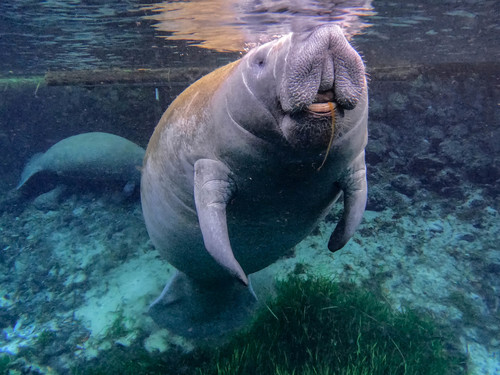
You might spot West Indian Manatee, Scarlet Skimmer, and Queen.
View guide →
Take the discovery with you
Snap it with Snappit to identify it, learn what makes it special, and add the discovery to your collection.












.jpg&width=800)




