




great horsetail
Equisetum telmateia
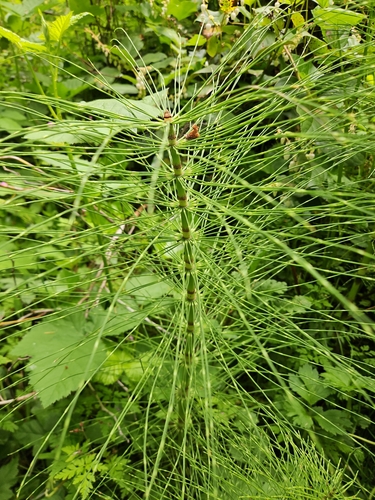
The great horsetail is a tall, green plant that looks like a giant green brush! It grows in wet places and is very special because it has been around for millions of years.
Habitat: Wetlands
The great horsetail has two distinct types of stems. Early fertile stems are unbranched, pale brown, and topped with a cone of spores. Later, sterile stems grow tall and vivid green with whorls of fine, brush-like branches, resembling a miniature fir tree.
Category
PlantsRarity
Common
Danger
1/5 · Very low
Snaps
16
Ancient plant relatives grew as tall as trees during the age of dinosaurs!
Each spore has spring-like elaters, helping it jump and fly in the wind!
It breathes through tiny holes called stomata, mostly on its branches!
Its rough stems were once used by pioneers to scrub pots and pans!
Great horsetail has silica crystals in its stems that make it strong and abrasive, helping it deter munching animals.
Great horsetail can spread tiny, dust-like spores that float on the wind to grow new plants, helping it colonize damp areas.
Great horsetail grows long underground stems called rhizomes, allowing it to rapidly spread and form large colonies.
Lema cyanella
Larvae and adults feed on horsetail stems.
Rana temporaria
Hides among its dense stems near water.
Thamnophis sirtalis
Hides within thick horsetail growth near water.
Describes organisms capable of converting atmospheric nitrogen into compounds usable by plants.
Grass-like plants are herbaceous plants that visually resemble true grasses, typically having long, narrow leaves.
Spore-producing organisms reproduce by releasing small, often single-celled, reproductive units called spores.
This trait signifies organisms belonging to a very old evolutionary group with ancestors dating back millions of years.

Describes organisms that break down dead organic material, recycling nutrients back into the ecosystem.

This trait characterizes organisms with an exceptionally long lifespan compared to others of their kind.

This habitat trait identifies species found in wetlands, which are areas of land saturated with water, either permanently or seasonally, including marshes, swamps, and bogs.

Giant describes organisms or objects of significantly larger size than average for their species or type.
No aliases listed yet.
Danger
1/5 · Very low
Always look but don't touch plants you don't know, as some can be harmful.
The easiest way to identify great horsetail is to use the Snappit nature identifier app.
20-100 cm
30-150 cm
No
Mild
Perennial
Wind
Wetlands
Zoom in to split clusters and explore where this object has been snapped.
May 25, 2026
Hoyt ArboretumPhoto attribution
no rights reserved
License: CC0 1.0 ↗
Image may be shown cropped inside the card frame.

Washington, US
You might spot Pacific Tree Frog and Long-Toed Salamander.
View guide →

Washington, US
You might spot Pacific Banana Slug and Oregon Forestsnail.
View guide →

Washington, US
You might spot Bigleaf Maple, Mule Deer, and Oregon Grape.
View guide →

Oregon, US
You might spot Rough-Skinned Newt and Isabella Tiger Moth.
View guide →

Washington, US
You might spot Western Skunk Cabbage, Thimbleberry, and Barred Owl.
View guide →

Washington, US
You might spot Thimbleberry, Modesty, and Arctic Butterbur.
View guide →
Take the discovery with you
Snap it with Snappit to identify it, learn what makes it special, and add the discovery to your collection.









.jpg&width=800)



_001.jpg&width=800)



