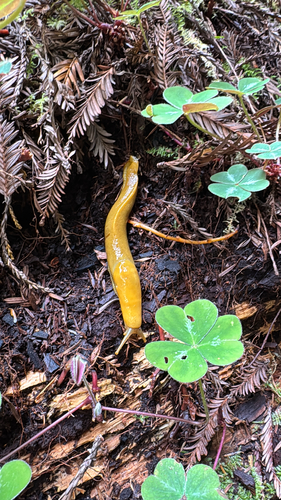
Banana Slug

Redwood National and State Parks protects the world's tallest trees, a dramatic coastline, and diverse ecosystems.
Redwood National and State Parks protects the world's tallest trees, a dramatic coastline, and diverse ecosystems. This collaborative group of parks, comprising Redwood National Park and three California State Parks—Jedediah Smith, Del Norte Coast, and Prairie Creek Redwoods—safeguards nearly half of the planet's remaining old-growth coast redwood forests. Here, visitors are immersed in a primeval landscape where ancient trees, some over 2,000 years old and towering more than 370 feet, create an awe-inspiring cathedral of nature.
Beyond the iconic coastal redwoods (Sequoia sempervirens), the parks offer a mosaic of habitats, including pristine rivers like the Smith River, open prairies, and 37 miles of rugged Pacific coastline. Key highlights include the enchanting Fern Canyon, with its 50-foot walls draped in lush ferns, and the tranquil Stout Grove, renowned for its dense stand of ancient giants. Visitors can also spot majestic Roosevelt elk grazing in meadows such as Elk Prairie, and a variety of marine life, including California sea lions, Steller sea lions, and harbor seals along the coast.
A visit to Redwood National and State Parks is an unforgettable journey into a living monument of natural history. It's a place where the sheer scale of nature humbles and inspires, offering serene walks beneath the tallest trees on Earth, exhilarating coastal views, and opportunities to connect with diverse wildlife. The parks provide a unique and profound experience, leaving visitors with lasting memories of unparalleled natural grandeur and the importance of conservation. Eager to name that creature? Identify any animal you find during your visit using the Snappit app.
The history of Redwood National and State Parks is a rich tapestry woven with indigenous heritage, logging booms, and dedicated conservation efforts. For millennia, indigenous communities such as the Yurok, Tolowa, Hupa, and Karuk have called this region home, deeply connected to the redwood forests and coastal areas. Their traditional practices and cultural presence remain strong within and around the parks today. However, the discovery of gold in California in 1850 spurred a massive influx of settlers, leading to extensive logging that drastically reduced the vast old-growth redwood forests. By the early 20th century, only a fraction of the original redwood forests remained. This destruction galvanized conservationists, leading to the formation of organizations like the Save the Redwoods League, which began purchasing large tracts of land to protect the remaining giants. These efforts led to the establishment of Jedediah Smith Redwoods, Del Norte Coast Redwoods, and Prairie Creek Redwoods State Parks in the 1920s. Despite these protections, logging continued, and it wasn't until 1968 that Redwood National Park was established, specifically to preserve some of the remaining uncut old-growth forests. The park was expanded in 1977 to better protect its watersheds, and in 1994, Redwood National Park and the three state parks were combined into a single administrative unit to facilitate cooperative management. In recognition of its rare ecosystem and cultural significance, the United Nations designated the parks a World Heritage Site in 1980.
Explore scenic drives, hike numerous trails ranging from easy loops to challenging treks, bike along forest roads, enjoy wildlife viewing (especially elk, marine mammals, and diverse birdlife), and participate in ranger-led programs. Tidepooling at places like Enderts Beach is also a popular activity during low tide.
Many visitor centers, picnic areas, campgrounds, and some trails are accessible to visitors with limited mobility. Wheelchairs and beach wheelchairs are available at various locations, and an all-terrain track chair can be reserved at the Kuchel Visitor Center for use on Freshwater Beach. Accessible trails include the Simpson-Reed Grove Trail, Lieffer Loop Trail, Big Tree Wayside, Revelation Trail, Karl Knapp/Foothills Trail, and parts of the Lady Bird Johnson Grove Trail.
A breathtaking flat loop trail through dense old-growth redwoods, perfect for photography.
Famous for its towering walls completely covered in ferns. A permit is required for entry between May 15th and September 15th.
A serene, higher-elevation loop trail often enveloped in coastal fog, offering a unique perspective of the ancient forest.
A stunning 10-mile paved drive through continuous old-growth redwoods, with numerous pull-offs and trailheads.
Each card links to a full Explore page with photos, traits, and fun facts.
Start with the big picture, then zoom in to explore individual wildlife observations around this place.
Download the NPS App
Cell service is notoriously spotty throughout the parks. Download the National Park Service app and relevant park content before your arrival for offline maps and information.
Don't Rely Solely on GPS
Popular driving apps can be inaccurate within the parks, especially on smaller roads. Use official park maps or the NPS app for reliable navigation.
Plan Accommodations Ahead
Campgrounds often require reservations, and hotels in the surrounding areas fill up quickly, particularly during peak season. Book well in advance.
Observe Elk from a Distance
Roosevelt elk are wild animals and can be aggressive, especially during calving season (May-June) or rutting season (fall). Maintain a safe distance of at least 25 yards.
Check for Permits and Road Conditions
Some popular areas like Fern Canyon (May 15 - Sept 15) and Tall Trees Grove require permits or reservations. Always check the park's website for current conditions, road closures, or fire restrictions before your visit.
Pack Layers and Rain Gear
The coastal weather can change rapidly. Even in summer, mornings can be foggy and cool. Be prepared for rain regardless of the season.
May 24, 2026
Photo attribution
no rights reserved
License: CC0 1.0 ↗
Image may be shown cropped inside the card frame.
May 24, 2026
Photo attribution
no rights reserved
License: CC0 1.0 ↗
Image may be shown cropped inside the card frame.
May 24, 2026
Photo attribution
no rights reserved
License: CC0 1.0 ↗
Image may be shown cropped inside the card frame.
Jun 19, 2026
Jun 19, 2026

Maryland, US
You might spot White-Tailed Deer and Eastern Gray Squirrel.
View guide →
.jpg)
District of Columbia, US
You might spot Eastern Gray Squirrel, Duck, and House Sparrow.
View guide →

Illinois, US
You might spot American Robin, Canada Goose, and House Sparrow.
View guide →

Virginia, US
You might spot Spotted Lanternfly and Northern Cardinal.
View guide →
Take the discovery with you
Identify the wildlife you spot, learn as you go, and keep a collection of the adventure.