





Gulf Fritillary
Dione vanillae
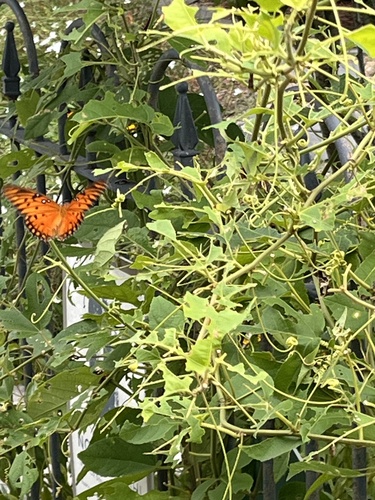
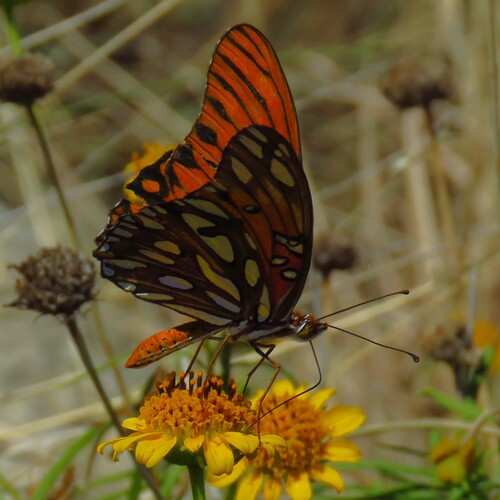
The Gulf Fritillary is a beautiful butterfly with bright orange wings and black spots. It loves to flutter around flowers and is often seen in gardens and fields.
Habitat: Urban areas, Coastal areas
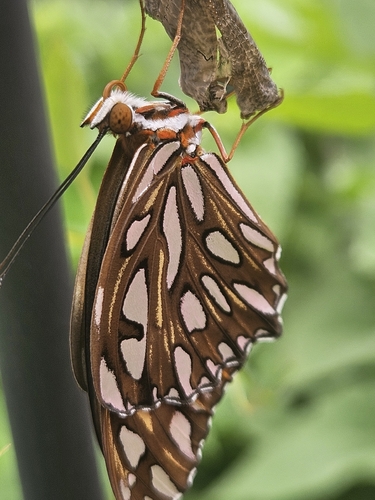
The Gulf Fritillary is a medium-sized butterfly with bright orange wings adorned with black markings. Its hindwings have distinct silvery-white spots on the underside, making it easily distinguishable from other orange butterflies.
Category
InsectsRarity
Common
Danger
1/5 · Very low
Snaps
89
Adult Gulf Fritillaries love to sip nectar from many different kinds of colorful flowers.
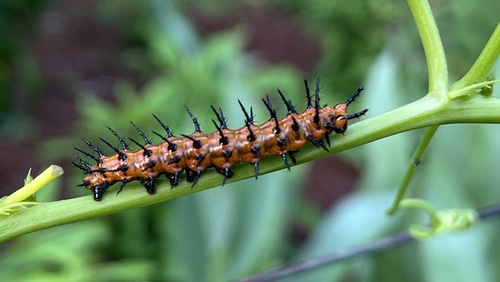
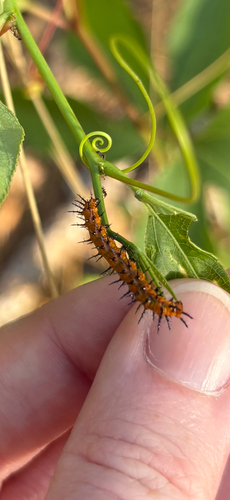
Its caterpillars have long, branched spines all over their body!
The bright orange wings warn predators that this butterfly tastes very bad to eat!
They often fly fast and erratically, making them tricky to catch or photograph!
Gulf Fritillary has a bitter taste from eating passionflower leaves that helps them deter hungry predators.
Gulf Fritillary has reflective silver spots on its hindwing undersides that help them blend with dappled light while resting.
Gulf Fritillary can fly quickly and erratically, which helps them escape from birds and other threats.
Caterpillars munch on leaves, while adults sip sweet flower nectar.
Age differences: Larvae consume passionflower leaves; adults feed exclusively on flower nectar and pollen.
Passiflora incarnata
Larvae consume leaves for growth and defense.
.jpg&width=800)
Lantana camara
Adults transfer pollen between its vibrant flowers.
.jpg&width=800)
Tyrannus tyrannus
Though bitter, some birds will still prey on them.
Marked with spots or patches of a different color.
Colorful describes organisms or objects displaying a wide range of bright and distinct colors.
This trait characterizes organisms whose diet consists entirely or primarily of plant material.
Describes plants that are particularly attractive and beneficial to a wide range of pollinating organisms.

Coastal habitats are dynamic environments located along the interface between land and sea, influenced by tides, waves, and saltwater.

Diurnal animals are primarily active during daylight hours, typically resting or sleeping at night.

This habitat trait indicates species that can coexist with humans in urban and suburban environments, utilizing man-made structures and green spaces.

Describes organisms that transfer pollen, enabling the fertilization and reproduction of plants.
Danger
1/5 · Very low
Butterflies are friendly, but it's best to watch them from a distance and not touch them.
The easiest way to identify Gulf Fritillary is to use the Snappit nature identifier app.
60-90 mm
30-40 mm
14-21 days
10 km/h
Caterpillars munch on leaves, while adults sip sweet flower nectar.
Urban areas, Coastal areas
Foraging
Zoom in to split clusters and explore where this object has been snapped.
Jun 20, 2026
BroadmoorPhoto attribution
(c) Elliot Greiner, some rights reserved (CC BY)
License: CC BY 4.0 ↗
Image may be shown cropped inside the card frame.
Jun 2, 2026
Algiers PointPhoto attribution
(c) willingarden, some rights reserved (CC BY)
License: CC BY 4.0 ↗
Image may be shown cropped inside the card frame.
Jun 2, 2026
Matanzas State ForestPhoto attribution
(c) Pam Kleinsasser, some rights reserved (CC BY)
License: CC BY 4.0 ↗
Image may be shown cropped inside the card frame.
Apr 21, 2026
Morningside Nature CenterPhoto attribution
(c) Emily Geest, some rights reserved (CC BY)
License: CC BY 4.0 ↗
Image may be shown cropped inside the card frame.
Oct 17, 2025
Fort LancasterPhoto attribution
(c) Annika Lindqvist, some rights reserved (CC BY)
License: CC BY 4.0 ↗
Image may be shown cropped inside the card frame.

Florida, US
You might spot Anole, Eastern Box Turtle, and Golden Silk Spider.
View guide →

Tennessee, US
You might spot House Sparrow, Northern Mockingbird, and Gulf Fritillary.
View guide →

Georgia, US
You might spot Gulf Fritillary, Anole, and American Beautyberry.
View guide →

California, US
You might spot Monarch, Bee, and Anise Swallowtail.
View guide →

Louisiana, US
You might spot Brown Anole, White Ibis, and Duck.
View guide →

Texas, US
You might spot Eastern Fox Squirrel and Great-Tailed Grackle.
View guide →
Take the discovery with you
Snap it with Snappit to identify it, learn what makes it special, and add the discovery to your collection.







.jpg&width=800)



