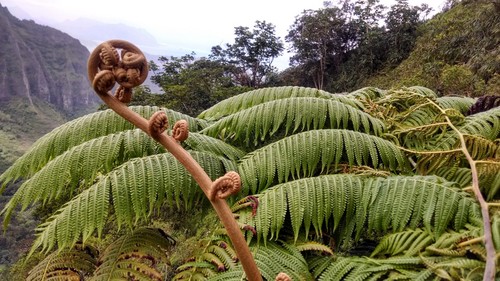


HāPu‘U Pulu
cibotium glaucum
The HāPu‘U Pulu (Cibotium glaucum) is a magnificent tree fern endemic to the Hawaiian Islands, where it serves as a keystone species of the wet montane rainforests. Reaching impressive heights, this ancient plant is famous for the soft, woolly, golden-brown fibers called "pulu" that wrap around its young, coiled fronds (fiddleheads). It plays an essential role in its ecosystem by acting as a living substrate, with its moist, fibrous trunk serving as a natural nursery for many native Hawaiian plants and epiphytes. Historically, Native Hawaiians and later settlers harvested the silky pulu for bedding stuffing and wound dressings. Today, it remains a symbol of Hawaii's lush, primordial wilderness, contributing significantly to forest water retention and biodiversity.
Habitat: Found in wet, tropical montane forests and rainforest understories across the Hawaiian Islands, thriving in areas with high rainfall and organic soils.
This large, slow-growing tree fern typically features a stout, upright trunk reaching 2 to 7 meters in height, crowned by a dense canopy of arching, lacy fronds that can span up to 3 meters in length. The tri-pinnate fronds are a rich, vibrant green on their upper surfaces, while their undersides exhibit a distinctive pale, glaucous bluish-green hue. The base of the leaf stalks is heavily clothed in a thick, velvety mass of golden-brown, silky hairs, which immediately distinguishes this species from other native ferns. Young fronds emerge as tightly coiled, woolly fiddleheads before unfurling into large, delicate leaf structures.
Category
PlantsRarity
Common
Danger
1/5 · Very low
Snaps
Be the first to snap!
During historical times of famine, the starch-rich core of the trunk and young fiddleheads were baked and eaten as emergency food.
In the 19th century, tons of the silky pulu fiber were commercially harvested and shipped to California to stuff pillows and mattresses.
In traditional Hawaiian medicine, the soft pulu fibers were applied directly to wounds to absorb blood and promote clotting.
Its fibrous, moisture-wicking trunk provides a highly hospitable, damp microhabitat that allows other native plants and mosses to germinate and grow on it.
The thick layers of silky pulu hairs collect condensation and rainwater, protecting the vulnerable young fiddleheads from desiccation.
Produces millions of tiny, lightweight spores that are easily carried by tropical forest breezes over vast volcanic landscapes.
As a photosynthetic plant, it generates its own sugars using sunlight, water, and carbon dioxide, while absorbing water and key minerals through its shallow root system.
Metrosideros polymorpha
Often begins life as an epiphyte on the fibrous trunk of the tree fern before growing roots into the forest floor.
Drepanis coccinea
Uses the dense canopy of the tree fern for nesting and seeks out insects among its fronds.
No trait badges are assigned for this object yet.
No aliases listed yet.
Collections for this object will appear here as more themes are added.
Danger
1/5 · Very low
No special safety notes yet.
Compare frond shape, how the leaflets are arranged, the stalk, and any spore clusters you can see. A single detached leaflet often hides the plant's overall growth pattern. Fern Identifier: upload a photo and compare the visible details.
200-700 cm
50-150 years
As a photosynthetic plant, it generates its own sugars using sunlight, water, and carbon dioxide, while absorbing water and key minerals through its shallow root system.
Found in wet, tropical montane forests and rainforest understories across the Hawaiian Islands, thriving in areas with high rainfall and organic soils.
Zoom in to split clusters and explore where this object has been snapped.
Recent snaps will appear here as new observations are added.
Take the discovery with you
Snap it with Snappit to identify it, learn what makes it special, and add the discovery to your collection.