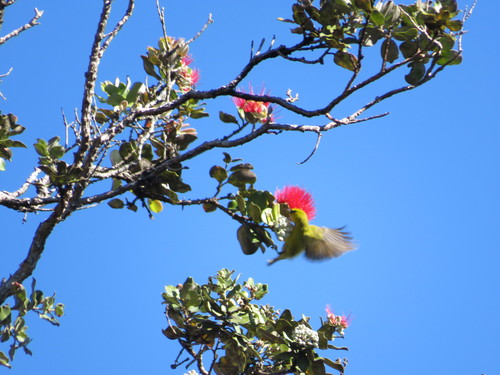


HawaiʻI ʻAmakihi
chlorodrepanis virens
The Hawaiʻi ʻAmakihi is one of the most common and resilient of the remaining native Hawaiian honeycreepers. Found primarily on the islands of Hawaiʻi, Maui, and Molokaʻi, this small, active bird plays a vital role in its ecosystem as both a pollinator and an insect predator. While many other Hawaiian forest birds have suffered drastic population declines due to introduced diseases, the Hawaiʻi ʻAmakihi has shown a remarkable ability to adapt, with some populations developing resistance to avian malaria and returning to lower elevations.
Habitat: Typically found in native Hawaiian forests, particularly wet, mesic, and dry woodlands dominated by ʻōhiʻa lehua and koa trees.
The Hawaiʻi ʻAmakihi is a small, compact bird measuring about 10 to 12 centimeters in length. Males are a bright yellow-green on their heads and breasts, fading to a duller olive-green on their backs and wings, with a distinct dark mask or smudge between the eye and the bill. Females and juveniles are much duller, displaying a drab, olive-gray coloration with subtle wing-bars. Its most defining physical feature is its short, sharply decurved, dark-colored bill, which is perfectly adapted for probing flowers and bark.
Category
BirdsRarity
Common
Danger
1/5 · Very low
Snaps
1
It is a highly vocal species, using its distinctive buzzy call to defend feeding territories from other birds, including larger honeycreepers.
Its tongue is curled into a tube-like shape and fringed at the tip, acting like a straw for extracting nectar.
The Hawaiʻi ʻAmakihi is one of the very few native forest birds in Hawaii that is successfully adapting to and colonizing low-elevation habitats where mosquito-borne avian malaria is rampant.
Unlike most other native Hawaiian honeycreepers, some low-elevation populations have evolved a genetic tolerance to avian malaria, allowing them to survive in areas where other species perish.
Possesses a specialized, brush-tipped tubular tongue that can curl to efficiently lap up nectar from native tubular flowers.
Highly agile flyer and climber, capable of foraging upside down along tree trunks, branches, and leaves in search of small insects.
Feeds primarily on nectar from native flowers and small invertebrates gleaned from foliage and bark, occasionally eating fruit.
Metrosideros polymorpha
Feeds extensively on the nectar of this dominant native canopy tree, acting as an important pollinator.
Culex quinquefasciatus
Receives transmission of avian malaria from this introduced insect vector, though some bird populations have developed tolerance.
Vespula pensylvanica
Competes directly for nectar and small insects within the native Hawaiian forest canopy.
No trait badges are assigned for this object yet.
No aliases listed yet.
Collections for this object will appear here as more themes are added.
Danger
1/5 · Very low
No special safety notes yet.
Compare the silhouette, bill shape, tail length, wing bars and markings around the eyes. The same small brown bird at your feeder can look quite different in breeding plumage, winter plumage or its first year. Bird Identifier: upload a photo and compare the visible details.
10-12 cm
15-18 cm
0.01-0.02 kg
3-10 years
35 km/h
Feeds primarily on nectar from native flowers and small invertebrates gleaned from foliage and bark, occasionally eating fruit.
Typically found in native Hawaiian forests, particularly wet, mesic, and dry woodlands dominated by ʻōhiʻa lehua and koa trees.
Zoom in to split clusters and explore where this object has been snapped.

Hawaii, US
You might spot ʻōhiʻa Lehua and Stinking Passionflower.
View guide →

Hawaii, US
You might spot 'āhinahina, Jackson's Chameleon, and Sea Turtle.
View guide →

Hawaii, US
You might spot 'āhinahina, Jackson's Chameleon, and Hawaiʻi ʻamakihi.
View guide →
Take the discovery with you
Snap it with Snappit to identify it, learn what makes it special, and add the discovery to your collection.