.jpg&width=800)





interior sandbar willow
Salix interior
The interior sandbar willow is a friendly plant that grows near rivers and wetlands. It has long, slender leaves and can help make the soil strong and healthy.
Habitat: Wetlands
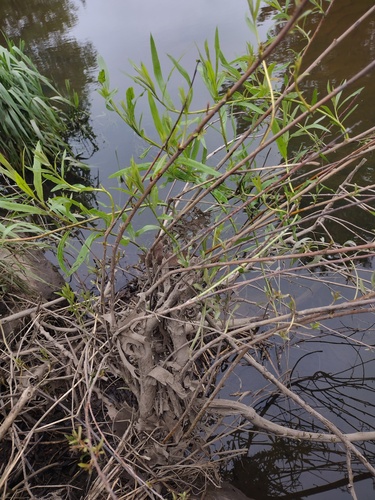
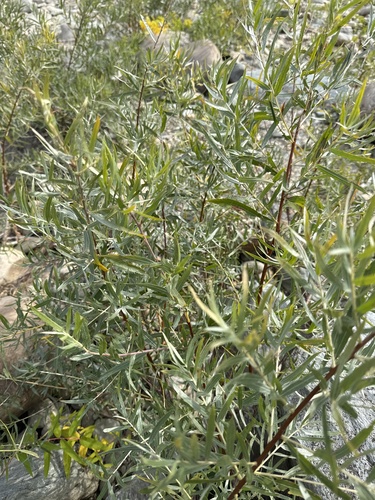
The interior sandbar willow is a shrub or small tree, forming dense thickets with many slender, reddish-brown stems. Its long, narrow, bright green leaves have finely toothed edges, giving the plant a delicate texture. Small, fuzzy catkins appear in early spring.
Category
PlantsRarity
Common
Danger
1/5 · Very low
Snaps
6
Before aspirin, people chewed willow bark for pain relief thanks to a special compound!
Its wood is so light, Indigenous peoples once used it for making arrows!
Sandbar willows help filter water, keeping rivers cleaner for fish and other creatures!
The scientific name 'Salix interior' means 'willow of the interior,' describing its habitat.
Interior sandbar willow can sprout new plants from broken branches and stems, helping it quickly colonize new areas along waterways.
It has an extensive root system that holds soil together, preventing erosion and helping it thrive in sandy, moist riverbanks.
The interior sandbar willow grows very fast, allowing it to recover quickly after floods or other disturbances.
Castor canadensis
Beavers eat willow branches and bark for food.

Odocoileus virginianus
Deer browse on young willow twigs and foliage.

Bombus impatiens
Bumble bees are important early-season pollinators.

Papilio glaucus
Butterfly larvae feed on willow leaves.
Deciduous plants periodically shed all their leaves, typically during autumn or dry seasons.
Flowering plants are any plants that produce flowers as part of their reproductive cycle.
A shrub is a woody plant smaller than a tree, typically with multiple stems branching from or near the ground.
Rapid growing plants exhibit accelerated growth rates, quickly increasing in size and biomass within a short period.

This habitat trait identifies species found in wetlands, which are areas of land saturated with water, either permanently or seasonally, including marshes, swamps, and bogs.

Freshwater habitats include non-saline aquatic environments such as rivers, lakes, ponds, and wetlands, vital for numerous species.

Describes a species whose presence and role have a disproportionately large effect on its environment.
No aliases listed yet.
Danger
1/5 · Very low
Always stay on paths and don't eat plants unless a grown-up says it's safe.
The easiest way to identify interior sandbar willow is to use the Snappit nature identifier app.
100-600 cm
100-300 cm
1-3 cm
Early spring
No
None
Perennial
Zoom in to split clusters and explore where this object has been snapped.
May 27, 2026
Ridgewood Historic DistrictPhoto attribution
no rights reserved
License: CC0 1.0 ↗
Image may be shown cropped inside the card frame.
Sep 22, 2025
Stockbridge Common Historic DistrictPhoto attribution
(c) naturalist charlie, some rights reserved (CC BY)
License: CC BY 4.0 ↗
Image may be shown cropped inside the card frame.

Ohio, US
You might spot Widow Skimmer, Eastern Pondhawk, and Bee.
View guide →

Ohio, US
You might spot Brown-Belted Bumble Bee and Eastern Carpenter Bee.
View guide →

Ohio, US
You might spot Spotted Lanternfly, Virginia Springbeauty, and Blue Phlox.
View guide →

Ohio, US
You might spot Blue-Ringed Dancer, Bee, and American Rubyspot.
View guide →

Indiana, US
You might spot Eastern Skunk Cabbage, Sassafras, and Red Columbine.
View guide →

Pennsylvania, US
You might spot Canada Goose and Common Eastern Bumble Bee.
View guide →
Take the discovery with you
Snap it with Snappit to identify it, learn what makes it special, and add the discovery to your collection.







.jpg&width=800)



_001.jpg&width=800)




