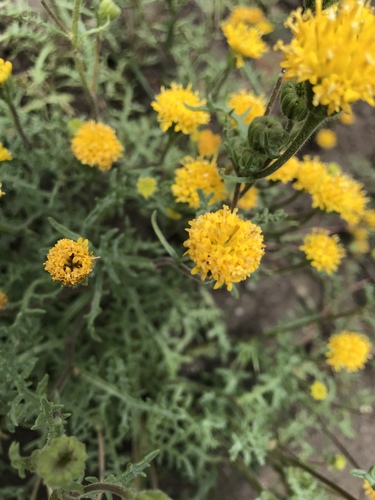


John Day Pincushion
chaenactis nevii
The John Day Pincushion (Chaenactis nevii) is a fascinating, rare annual wildflower native only to the scenic badlands of north-central Oregon. Thriving in the harsh, alkaline clay of the John Day Formation, this resilient little plant adds a splash of vibrant color to an otherwise barren, volcanic landscape. Its name perfectly captures the visual of its tightly packed floral heads, which look like tiny yellow pincushions nestled among grey-green leaves. Botanists and plant lovers travel from afar to catch a glimpse of this highly specialized endemic species during its brief spring bloom. Adapting to survive in soils rich in minerals but poor in nutrients, it represents a remarkable evolutionary success story of desert adaptation.
Habitat: Found exclusively on alkaline clay soils and volcanic ash exposures within the arid shrub-steppe of the John Day River basin.
This small annual herb typically grows 10 to 30 centimeters tall, featuring branching, glandular-pubescent stems that give it a slightly sticky feel. Its leaves are deeply lobed, dusty green to grayish in color, and form a low rosette before extending up the stem. The most identifying feature is its flower head: a compact, discoid cluster of bright, golden-yellow tubular florets. Unlike other pincushions, it lacks showy ray petals, giving the bloom a distinctive, dome-shaped pincushion appearance that contrasts sharply with the pale clay soils it inhabits.
Category
PlantsRarity
Common
Danger
1/5 · Very low
Snaps
2
It is a strict endemic to Oregon, meaning it grows wild absolutely nowhere else on Earth except around the John Day River basin.
Its seeds can remain dormant in dry desert soil for multiple years, waiting to sprout only when winter rainfall is sufficient.
This species is one of the very few pincushion flowers in its genus that blooms bright yellow instead of white or pink.
Successfully extracts moisture and nutrients from highly alkaline, mineral-rich clays derived from volcanic ash where most other plants cannot survive.
Rapidly germinates, flowers, and sets seed in a matter of weeks during spring to evade the scorching heat of the summer desert.
Possesses sticky glandular hairs on its stems and leaves that deter crawling herbivorous insects and reduce water loss.
As an autotrophic plant, it utilizes chlorophyll to produce its own food through photosynthesis, capturing sunlight and absorbing essential minerals directly from the soil.
_Halictus_rubicundus_on_Jacobaea_vulgaris_-_Villeneuve-les-Bouloc_France.jpg&width=800)
Halictus rubicundus
Feeds on the nectar and pollen, acting as the primary pollinator for this specialized wildflower.

Artemisia tridentata
Provides sparse ground cover and competes for moisture in the arid clay soils.
.jpg&width=800)
Sylvilagus nuttallii
Occasionally grazes on the foliage of young plants despite their bitter, glandular defenses.
No trait badges are assigned for this object yet.
No aliases listed yet.
Collections for this object will appear here as more themes are added.
Danger
1/5 · Very low
No special safety notes yet.
The easiest way to identify John Day Pincushion is to use the Snappit nature identifier app.
10+ cm
As an autotrophic plant, it utilizes chlorophyll to produce its own food through photosynthesis, capturing sunlight and absorbing essential minerals directly from the soil.
Found exclusively on alkaline clay soils and volcanic ash exposures within the arid shrub-steppe of the John Day River basin.
Zoom in to split clusters and explore where this object has been snapped.
Take the discovery with you
Snap it with Snappit to identify it, learn what makes it special, and add the discovery to your collection.










.jpg&width=800)



_001.jpg&width=800)




