

Kangaroos, Wallabies And Allies
macropodidae
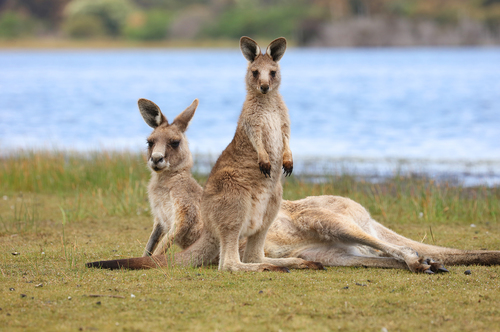
Macropodidae, commonly known as kangaroos, wallabies, and their allies, comprise a diverse family of marsupials native to Australia and New Guinea. These iconic animals are renowned for their powerful hind legs, muscular tails, and unique hopping locomotion, which allows them to cover vast distances efficiently across various landscapes. As marsupials, macropods give birth to highly altricial young, which then complete their development in a maternal pouch. The family exhibits a wide range of sizes and adaptations, from the smallest tree-kangaroos to the largest red and grey kangaroos, playing crucial roles as primary consumers in their respective ecosystems. Their adaptability and specialized herbivorous diets have enabled them to thrive in environments ranging from arid deserts to lush rainforests.
Habitat: Macropods inhabit a diverse range of Australian and New Guinean environments, including open grasslands, woodlands, savannas, shrublands, and even tropical rainforests and rocky outcrops.
Macropods vary significantly in size, but all share a general body plan characterized by disproportionately large, powerful hind legs, small forelimbs, and a thick, muscular tail used for balance and support. Their fur coloration ranges from various shades of grey and brown to reddish-brown, often with lighter undersides. Ears can be prominent and mobile, and their heads are relatively small with distinct muzzles. Species like the Red Kangaroo are large and reddish, while Grey Kangaroos are typically larger and grey. Wallabies tend to be smaller, often with more varied patterns or markings depending on the species.
Category
MammalsRarity
Common
Danger
1/5 · Very low
Snaps
Be the first to snap!
A group of kangaroos is called a mob, troop, or herd.
Female kangaroos can determine the sex of their joey and also delay the implantation of a fertilized egg, a process known as embryonic diapause.
Kangaroos cannot walk backwards; their large tails and powerful legs are adapted for forward motion.
The Red Kangaroo is the largest marsupial in the world.
Kangaroos and wallabies are masters of bipedal hopping. This energy-efficient form of movement is powered by large tendons acting as springs, allowing them to cover large distances while conserving energy.
Macropods give birth to extremely underdeveloped young, called joeys, after a very short gestation period. These tiny joeys crawl into the mother's pouch where they attach to a nipple and complete their development.
Many macropod species can halt the development of an embryo at an early stage. This allows the mother to have multiple young at different developmental stages, or to delay a new birth until environmental conditions are more favorable.
Macropods are primarily herbivorous, feeding on a wide variety of plant matter. Their digestive systems are adapted for breaking down fibrous plant material through foregut fermentation, similar to ruminants.
Age differences: Joeys initially feed exclusively on milk within the pouch, gradually transitioning to solid plant matter as they mature.
Canis dingo
A primary predator of kangaroos and wallabies, especially the young.
Aquila audax
Preys on smaller wallabies and juvenile kangaroos.
Themeda triandra
Primary food source for grazing macropods.

Vulpes vulpes
In some areas, foxes are significant predators of young macropods.
No trait badges are assigned for this object yet.
No aliases listed yet.
Collections for this object will appear here as more themes are added.
Danger
1/5 · Very low
No special safety notes yet.
Compare ears, muzzle, tail, feet and coat markings. Size is hard to judge without something nearby for scale, and young mammals may not have adult coloring yet. Mammal Identifier: upload a photo and compare the visible details.
30-160 cm
0.7-90 kg
5-20 years
70 km/h
Macropods are primarily herbivorous, feeding on a wide variety of plant matter. Their digestive systems are adapted for breaking down fibrous plant material through foregut fermentation, similar to ruminants.
Macropods inhabit a diverse range of Australian and New Guinean environments, including open grasslands, woodlands, savannas, shrublands, and even tropical rainforests and rocky outcrops.
Grazing, Foraging
Zoom in to split clusters and explore where this object has been snapped.
Recent snaps will appear here as new observations are added.

Municipal District of Cobh, IE
You might spot Ring-Tailed Lemur, Giraffes, and Cheetahs.
View guide →

New York, US
You might spot Giraffes, Kangaroos, Wallabies and Allies, and Capybara.
View guide →

Oklahoma, US
You might spot Asian Elephant, Giraffes, and African Lion.
View guide →

Nevada, US
You might spot Barbary Macaque, Chimpanzee, and African Lion.
View guide →

England, UK
You might spot Asian Elephant, Gorilla, and Bornean Orangutan.
View guide →

Illinois, US
You might spot African Penguin, Wolverine, and Black Bear.
View guide →
Take the discovery with you
Snap it with Snappit to identify it, learn what makes it special, and add the discovery to your collection.