





Keeled Treehopper
Entylia carinata
The Keeled Treehopper is a small, colorful insect that loves to jump around on plants. Its unique shape helps it blend in with leaves, making it hard to spot!
Habitat: Forests
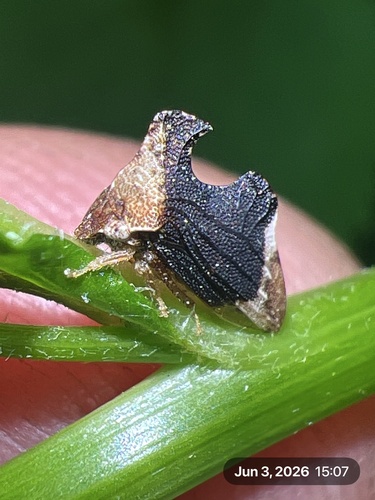
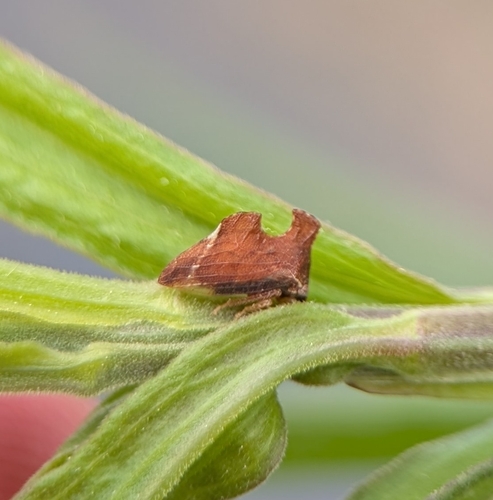
The Keeled Treehopper has a distinctive, helmet-like pronotum that extends over its head and body, often featuring a prominent, jagged crest or keel. Its body is typically mottled brown, black, or greenish, providing excellent camouflage against plant stems. This unique shape makes it look like a thorn or a piece of debris.
Category
InsectsRarity
Common
Danger
1/5 · Very low
Snaps
11
Many treehopper babies get protection from ants, who love their sweet, sugary honeydew!
The Keeled Treehopper's spiky "helmet" is actually an overgrown part of its thorax!
These insects are related to cicadas and leafhoppers, sharing a sap-sucking lifestyle!
They have special padded feet that help them grip plants, even when it's windy!
Keeled Treehopper has a thorn-like body shape and mottled coloration that helps them hide from predators by blending perfectly with plant stems.
Keeled Treehopper can send and receive secret messages through plant stems using vibrations, which helps them find mates and warn others of danger.
Keeled Treehopper can make powerful leaps with its strong hind legs, allowing them to escape quickly when threatened by predators.
Keeled Treehopper can access plant sap with its specialized piercing-sucking mouthparts, which helps them get all the nutrients they need.
They drink sugary sap from plants using their straw-like mouths.
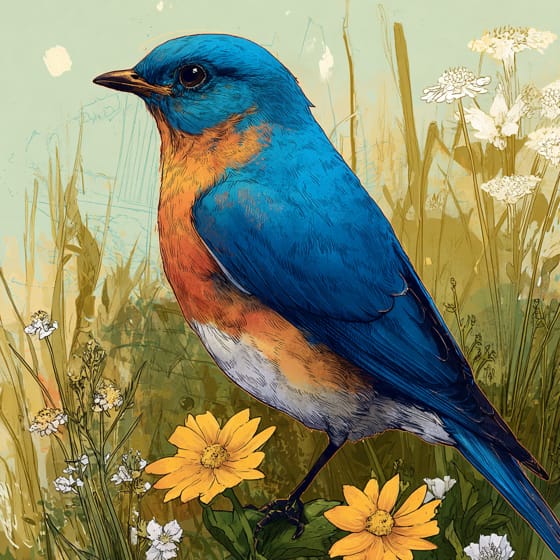
Sialia sialis
Birds often prey on treehoppers for a quick, nutritious meal.
Araneus diadematus
Spiders capture Keeled Treehoppers in their webs or by ambush.
Formica subsericea
Ants protect treehopper nymphs from predators in exchange for honeydew.
Social animals live in organized groups, cooperating for survival benefits such as foraging, defense, and raising offspring.
Camouflaged describes organisms that possess coloring or patterns that allow them to blend into their environment.
Colorful describes organisms or objects displaying a wide range of bright and distinct colors.
This trait characterizes organisms whose diet consists entirely or primarily of plant material.

Forest habitats are terrestrial environments dominated by dense tree cover, supporting a high diversity of plant and animal life.

Diurnal animals are primarily active during daylight hours, typically resting or sleeping at night.

Describes organisms that transfer pollen, enabling the fertilization and reproduction of plants.
No aliases listed yet.
Danger
1/5 · Very low
It's best to watch insects from a distance and not touch them.
The easiest way to identify Keeled Treehopper is to use the Snappit nature identifier app.
7-10 mm
4-7 mm
30-60 days
They drink sugary sap from plants using their straw-like mouths.
Forests
6
Zoom in to split clusters and explore where this object has been snapped.
Jun 3, 2026
Bedford Village Historic DistrictPhoto attribution
(c) Healthy Yards, some rights reserved (CC BY)
License: CC BY 4.0 ↗
Image may be shown cropped inside the card frame.
May 29, 2026
Davisville Historic DistrictPhoto attribution
(c) Tyler Ekholm, some rights reserved (CC BY)
License: CC BY 4.0 ↗
Image may be shown cropped inside the card frame.

Ohio, US
You might spot Spotted Lanternfly and White-Tailed Deer.
View guide →

Connecticut, US
You might spot Common Mugwort and Canada Goose.
View guide →

Rhode Island, US
You might spot Common Eastern Bumble Bee and Asian Lady Beetle.
View guide →

Massachusetts, US
You might spot Turkey, Garter Snake, and Multiflora Rose.
View guide →

Pennsylvania, US
You might spot Tree-Of-Heaven, Spotted Lanternfly, and American Tuliptree.
View guide →

New York, US
You might spot White-Tailed Deer, Common Mugwort, and Garlic Mustard.
View guide →
Take the discovery with you
Snap it with Snappit to identify it, learn what makes it special, and add the discovery to your collection.







.jpg&width=800)


