
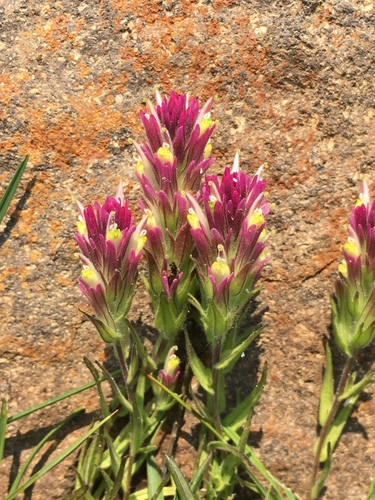


Lassen Paintbrush
castilleja lassenensis
The Lassen Paintbrush (Castilleja lassenensis) is a captivating subalpine wildflower endemic to the volcanic slopes and high meadows of Northern California, particularly around its namesake, Lassen Volcanic National Park. As a member of the broomrape family, this perennial herb exhibits a fascinating hemiparasitic lifestyle, utilizing subterranean root connections called haustoria to siphon water and essential nutrients from neighboring grasses, lupines, and shrubs. Despite its parasitic habits, it is fully capable of photosynthesis, showcasing a brilliant balance of self-sufficiency and opportunistic adaptation. In late spring and summer, this species paints rugged volcanic landscapes with vibrant clusters of magenta and pink-purple, serving as an important nectar source for high-altitude pollinators.
Habitat: Found in rocky subalpine and alpine volcanic meadows, gravelly scree slopes, and open coniferous forest edges of the southern Cascade Range.
Lassen Paintbrush typically grows in erect, clumped stems reaching 10 to 30 centimeters in height, covered in fine, soft hairs with lance-shaped, grayish-green leaves. Its most striking visual feature is the dense, brush-like floral spike at the top of the stem, consisting of showy, deeply lobed bracts ranging in color from pale pinkish-purple to rich magenta. The actual flowers are small, tube-like, and relatively inconspicuous, tucked discreetly inside these brightly colored bracts.
Category
PlantsRarity
Common
Danger
1/5 · Very low
Snaps
Be the first to snap!
Because they rely on complex subterranean networks of host roots to survive, these plants are incredibly difficult to propagate or transplant successfully.
By parasitizing dominant grasses, paintbrushes help keep aggressive plants in check, promoting greater wildflower diversity in subalpine meadows.
The brilliant pink and magenta structures are actually modified leaves called bracts, which protect the plant's tiny, tube-like green flowers.
Utilizes specialized root structures to tap into neighboring plants, extracting water and minerals to supplement its own growth.
Siphons toxic secondary compounds from host plants, making itself unpalatable to browsing herbivores.
Thrives in nutrient-poor, porous volcanic scree where few other plant species can establish.
Lassen Paintbrush produces its own sugars through photosynthesis but relies heavily on host plants to siphon water and mineral nutrients.
Age differences: Seedlings are fully self-sufficient until their root systems develop enough to latch onto a nearby host plant.

Artemisia tridentata
The paintbrush taps into the roots of this shrub to steal water and vital nutrients.

Selasphorus rufus
Feeds on the nectar of the flowers, acting as a primary pollinator in high-altitude environments.

Lupinus latifolius
Serves as an ideal nitrogen-rich host plant, enabling the paintbrush to thrive in poor soils.
No trait badges are assigned for this object yet.
No aliases listed yet.
Collections for this object will appear here as more themes are added.
Danger
1/5 · Very low
No special safety notes yet.
Start with the whole plant, then compare leaf arrangement, leaf edges, stems and any flowers or fruit. Opposite leaves grow in pairs; alternate leaves come one at a time along the stem. These details tell you far more together than a single green leaf does. Plant Identifier: upload a photo and compare the visible details.
10-30 cm
0.02-0.08 kg
3-8 years
Lassen Paintbrush produces its own sugars through photosynthesis but relies heavily on host plants to siphon water and mineral nutrients.
Found in rocky subalpine and alpine volcanic meadows, gravelly scree slopes, and open coniferous forest edges of the southern Cascade Range.
Foraging
Zoom in to split clusters and explore where this object has been snapped.
Recent snaps will appear here as new observations are added.
Take the discovery with you
Snap it with Snappit to identify it, learn what makes it special, and add the discovery to your collection.


















