





Ligated Furrow Bee
Halictus ligatus
The Ligated Furrow Bee is a small, friendly bee that loves to buzz around flowers. They help plants grow by spreading pollen while they collect nectar to eat.
Habitat: Grasslands
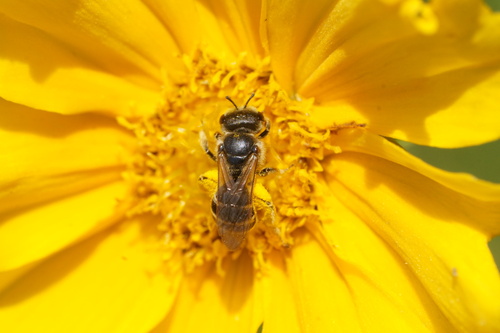
The Ligated Furrow Bee has a metallic greenish-gold head and thorax, contrasting with a darker, more slender abdomen. Its abdomen features faint, hairless indentations that give it a subtly striped look.
Category
InsectsRarity
Common
Danger
1/5 · Very low
Snaps
13
A special gland in their abdomen helps female Ligated Furrow Bees mark their underground territory.
The name "ligated" comes from the faint stripe-like indentations on their abdomen!
These bees can sometimes share a nest entrance, but still have their own private tunnels!
They often have two generations of bees born in a single year, one in spring and one in summer.
Ligated Furrow Bees can dig intricate burrows underground because they have strong mandibles and specialized legs for excavating soil, protecting their offspring.
Ligated Furrow Bees have fuzzy bodies that help them collect and transport pollen between flowers, allowing plants to produce seeds and fruits.
Ligated Furrow Bees can be solitary or semi-social, building small communal nests where a mother shares duties with her daughters.
These busy bees sip nectar for energy and collect pollen to feed their young!
Solidago canadensis
Visits common goldenrod flowers for nectar and pollen.

Taraxacum officinale
An important early season pollinator of dandelions.
Sphecodes arvensis
Female cuckoo bees lay eggs in Ligated Furrow Bee nests.
Misumena vatia
Ambush predators that often hide in flowers to catch bees.
Furry describes animals possessing a dense covering of soft hair or fur.
Social animals live in organized groups, cooperating for survival benefits such as foraging, defense, and raising offspring.
Grassland habitats are terrestrial biomes dominated by grasses and herbaceous plants, supporting a variety of grazing animals.
This trait characterizes organisms whose diet consists entirely or primarily of plant material.

Describes plants that are particularly attractive and beneficial to a wide range of pollinating organisms.

Diurnal animals are primarily active during daylight hours, typically resting or sleeping at night.

Describes organisms that transfer pollen, enabling the fertilization and reproduction of plants.
No aliases listed yet.
Danger
1/5 · Very low
Bees are usually friendly, but it's best to stay calm and not swat at them.
The easiest way to identify Ligated Furrow Bee is to use the Snappit nature identifier app.
8-15 mm
4-8 mm
30-180 days
These busy bees sip nectar for energy and collect pollen to feed their young!
Grasslands
Foraging
6
Zoom in to split clusters and explore where this object has been snapped.
Jun 5, 2026
Wesleyan GrovePhoto attribution
(c) Matt Pelikan, some rights reserved (CC BY)
License: CC BY 4.0 ↗
Image may be shown cropped inside the card frame.

Connecticut, US
You might spot Striped Wintergreen and Common Eastern Bumble Bee.
View guide →

Illinois, US
You might spot Brown-Belted Bumble Bee and Eastern Gray Squirrel.
View guide →

Connecticut, US
You might spot Striped Wintergreen and Common Eastern Bumble Bee.
View guide →

New York, US
You might spot Bald Eagle, Common Eastern Bumble Bee, and Red-Tailed Hawk.
View guide →

Rhode Island, US
You might spot American Herring Gull and White-Tailed Deer.
View guide →

Texas, US
You might spot Duck, Egyptian Goose, and Black-Bellied Whistling-Duck.
View guide →
Take the discovery with you
Snap it with Snappit to identify it, learn what makes it special, and add the discovery to your collection.





.jpg&width=800)




