Lionfish
Pterois volitans
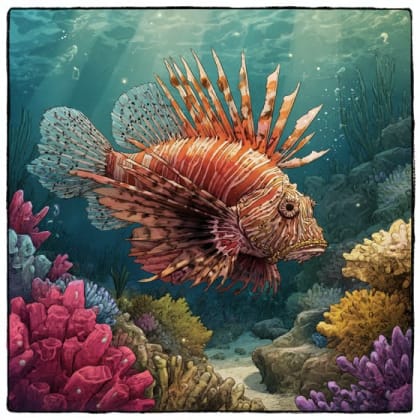
The Lionfish is a stunning fish with long, flowing fins. It is known for its beautiful appearance but can be dangerous if threatened.
Habitat: Coral reefs
The Lionfish has striking red, white, and black stripes with long, venomous spines on its dorsal, anal, and pelvic fins. Its elaborate, fan-like pectoral fins make it look much larger and more intimidating than other reef fish.
Category
FishRarity
Rare
Danger
2/5 · Low
Snaps
2
Female lionfish can release up to two million eggs each year.
Lionfish are a huge invasive problem in the Atlantic Ocean.
They can blow jets of water to disorient prey before eating them!
They can live up to 15 years in the wild.
Lionfish has sharp, venomous spines that help them protect against predators and deter threats.
Lionfish can use their large, fan-like fins to herd smaller fish into a corner before catching them.
Lionfish has striped patterns that help them blend into coral reefs, allowing them to surprise prey.
Lionfish are hunters that eat many kinds of small fish and crustaceans.
Age differences: Juveniles eat more invertebrates; adults primarily eat fish.
Chromis cyanea
A small reef fish often preyed upon by Lionfish.
Thalassoma bifasciatum
One of many small fish consumed by Lionfish.
Epinephelus striatus
A natural predator in native range; sometimes eats them.
Gymnothorax funebris
Moray eels have been observed hunting Lionfish.
Wildlife encompasses all undomesticated animal and plant life existing in their natural habitats.
An ambush predator hunts by patiently waiting and concealing itself, then launching a sudden attack when unsuspecting prey comes within range.
This trait identifies organisms whose diet consists entirely or primarily of animal tissue.
Aquatic habitats encompass environments where organisms live predominantly in water, including oceans, rivers, lakes, and wetlands.

Marine habitats encompass all saltwater environments of the Earth's oceans, supporting an immense diversity of aquatic life.

Nocturnal animals are primarily active during the nighttime hours, typically resting or sleeping during the day.

Venomous organisms produce toxins that are injected into another animal, typically through a bite or sting.
Danger
2/5 · Low
Watch quietly from a distance and never try to feed or chase wild animals.
The easiest way to identify Lionfish is to use the Snappit nature identifier app.
30-45 cm
0.5-2 kg
10-15 years
Lionfish are hunters that eat many kinds of small fish and crustaceans.
3 km/h
Coral reefs
Ambush
Zoom in to split clusters and explore where this object has been snapped.

US
You might spot Laughing Gull, Brown Anole, and Green Iguana.
View guide →

Ohio, US
You might spot Sand Tiger Shark, Nurse Shark, and Cow.
View guide →

Texas, US
You might spot White Tiger, Octopus, and Sand Tiger Shark.
View guide →

Florida, US
You might spot Brown Anole, Laughing Gull, and Green Iguana.
View guide →
Ohio, US
You might spot Sand Tiger Shark, Nurse Shark, and Cow.
View guide →

Florida, US
You might spot Laughing Gull, Brown Anole, and Green Iguana.
View guide →
Take the discovery with you
Snap it with Snappit to identify it, learn what makes it special, and add the discovery to your collection.