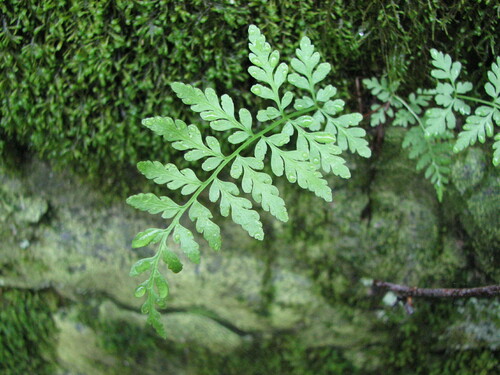


Mackay'S Fragile Fern
cystopteris tenuis
Mackay's Fragile Fern (Cystopteris tenuis) is a delicate and resilient perennial fern native to the rocky woodlands and cliffs of eastern North America. Named after the botanist A.H. Mackay, this species belongs to the fragile fern genus, characterized by its slender, easily broken stems and highly dissected, lace-like fronds. Unlike many other ferns that require deep, moist soils, this species thrives in crevices of rocky outcrops, cliffs, and talus slopes, where it anchors its short, creeping rhizomes. It is highly valued by native plant enthusiasts for its elegant appearance and ability to colonize challenging, shaded stone environments.
Habitat: Typically found in shaded rocky woods, moist cliffs, talus slopes, and limestone ledges.
This small-to-medium fern features delicate, light-green, bipinnate to pinnate-pinnatifid fronds that typically reach 10 to 40 centimeters in height. The fronds are lance-shaped and taper toward both ends, growing from a short, creeping rhizome. Its stem (stipe) is very slender, smooth, and fragile, showing a reddish-brown to straw-colored base. Underneath the pinnules, circular spore-producing structures called sori are partially covered by hood-like indusia, which shrivel and peel back as the spores mature in mid-to-late summer.
Category
PlantsRarity
Common
Danger
1/5 · Very low
Snaps
1
Despite its common name 'fragile fern', this plant is incredibly tough, often growing directly out of sheer rock walls where few other plants can survive.
Its species name 'tenuis' is Latin for 'thin' or 'slender', referring to the delicate, paper-thin texture of its leaflets.
Unlike many larger ferns, Mackay's Fragile Fern is known to go dormant and wither during dry midsummer heat waves, only to resurrect with fresh green fronds when autumn rains arrive.
Capable of anchoring its root-like rhizomes directly into narrow rock crevices and pockets of shallow soil on vertical cliff faces.
Can senesce (die back) during dry mid-summer spells and rapidly produce a fresh flush of new fronds when moisture returns in autumn.
Utilizes a specialized ring of cells (the annulus) on its sporangia that dries and snaps forward, forcefully launching microscopic spores into passing wind currents.
As a photosynthetic plant, Mackay's Fragile Fern synthesizes its own energy from sunlight, carbon dioxide, and water while absorbing key mineral nutrients through its roots.
Hyalopsora polypodii
A specialized rust fungus that infects the fronds, utilizing the fern as a host to complete its lifecycle.

Odocoileus virginianus
An herbivorous mammal that occasionally grazes on the delicate fronds in rocky, forested areas, especially in early spring.
Anomodon attenuatus
A shade-loving moss that often grows alongside this fern in moist rock crevices, competing for space and water.
No trait badges are assigned for this object yet.
No aliases listed yet.
Collections for this object will appear here as more themes are added.
Danger
1/5 · Very low
No special safety notes yet.
The easiest way to identify Mackay'S Fragile Fern is to use the Snappit nature identifier app.
10-40 cm
0.01-0.05 kg
5-15 years
As a photosynthetic plant, Mackay's Fragile Fern synthesizes its own energy from sunlight, carbon dioxide, and water while absorbing key mineral nutrients through its roots.
Typically found in shaded rocky woods, moist cliffs, talus slopes, and limestone ledges.
Zoom in to split clusters and explore where this object has been snapped.
Take the discovery with you
Snap it with Snappit to identify it, learn what makes it special, and add the discovery to your collection.












.jpg&width=800)



_001.jpg&width=800)




