

Milk Snail
otala lactea
The Milk Snail (Otala lactea), also known as the Spanish snail, is a highly adaptable terrestrial gastropod native to the Mediterranean basin. Renowned for its resilience, this species has successfully colonized various parts of the world, including North America and Bermuda, where it is often introduced through the pet trade or heliciculture. A fascinating aspect of its biology is its extreme drought tolerance; during dry, hot periods, it can enter a state of dormancy called estivation, sealing itself inside its shell with a mucus barrier to survive for months without active hydration.
Habitat: Found in dry, open habitats, including coastal scrublands, rocky hillsides, gardens, and agricultural fields where it clings to vegetation or rocks.
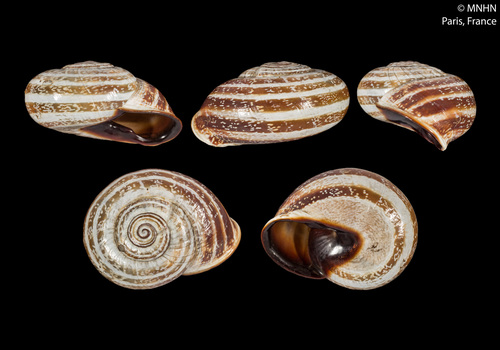
The Milk Snail features a robust, globose shell measuring about 2.5 to 4 cm in diameter. Its shell coloration is highly variable but generally displays a milky-white or cream background adorned with five distinct chocolate-brown spiral bands and delicate speckled patterns. A key diagnostic feature is the mature shell's aperture lip, which is strongly reflected and has a striking dark brown to nearly black interior rim, contrasting sharply with the pale outer shell. The snail's soft body is typically a pale brownish-gray or cream color.
Category
InvertebrateRarity
Common
Danger
1/5 · Very low
Snaps
5
During courtship, milk snails shoot microscopic calcified 'love darts' into each other's bodies to inject hormones that increase the chance of successful fertilization.
Milk snails have been consumed by humans for millennia, as evidenced by massive prehistoric shell middens found in caves across North Africa.
They are simultaneous hermaphrodites, meaning every individual possesses both male and female reproductive organs, though they still require a partner to mate.
Secretes a tough, parchment-like membrane of dried mucus over its shell opening to lock in moisture during periods of drought.
Enters a deep metabolic sleep that can last for several months to survive extreme heat and dry conditions.
Produces a specialized slime trail that lubricates its path, allowing it to glide harmlessly over sharp objects like thorns and rocks.
Feeds primarily on a wide variety of green plants, agricultural crops, and decaying organic matter.
Euglandina rosea
A carnivorous snail that aggressively hunts and preys upon milk snails in overlapping territories.

Erinaceus europaeus
Forages in gardens and open woodlands, regularly consuming milk snails as a key food source.

Cornu aspersum
Competes directly for food resources, shelter, and breeding sites in garden and agricultural ecosystems.
No trait badges are assigned for this object yet.
No aliases listed yet.
Collections for this object will appear here as more themes are added.
Danger
1/5 · Very low
No special safety notes yet.
Compare body symmetry, shells, segments, legs, tentacles and how the animal moves. Invertebrates span many unrelated groups, so start with body structure. Invertebrate Identifier: upload a photo and compare the visible details.
2+ cm
0.005+ kg
2+ years
Feeds primarily on a wide variety of green plants, agricultural crops, and decaying organic matter.
Found in dry, open habitats, including coastal scrublands, rocky hillsides, gardens, and agricultural fields where it clings to vegetation or rocks.
Grazing
50+
Zoom in to split clusters and explore where this object has been snapped.

California, US
You might spot Monarch, Canada Goose, and Western Gull.
View guide →

California, US
You might spot Northern Harrier and Black-Tailed Jackrabbit.
View guide →

California, US
You might spot Sunburst Anemone, Western Gull, and Giant Coreopsis.
View guide →

California, US
You might spot Eastern Fox Squirrel, Bee, and House Sparrow.
View guide →

Texas, US
You might spot Canada Goose, Duck, and Pond Slider.
View guide →
Take the discovery with you
Snap it with Snappit to identify it, learn what makes it special, and add the discovery to your collection.