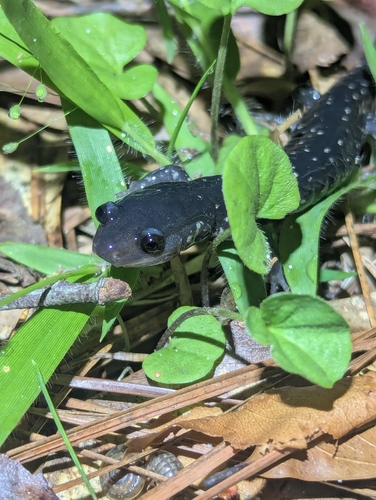


Mississippi Slimy Salamander
plethodon mississippi
The Mississippi Slimy Salamander (Plethodon mississippi) is a striking, terrestrial woodland amphibian native to the forested regions of Mississippi and neighboring areas in the southeastern United States. Like other members of the slimy salamander complex, this species is renowned for its incredible defense mechanism: a highly viscous, glue-like skin secretion released when threatened, which can easily gum up the mouth of a potential predator. This lungless salamander spends most of its life hidden in dark, humid microhabitats, such as under decaying logs or deep leaf litter. It plays an important role in forest ecosystems as an indicator of forest floor health and a controller of small invertebrate populations.
Habitat: Found in moist, mature deciduous or mixed hardwood forests, usually sheltering beneath rotting logs, flat rocks, and deep leaf litter.
This medium-sized salamander typically measures between 11 and 18 centimeters in length, featuring a sleek, dark black or dark grey body heavily speckled with bright, silvery-white or brassy flecks along its back and sides. It has a rounded snout, dark eyes, and a pale grey throat, with a robust tail that constitutes about half of its total length.
Category
AmphibiansRarity
Common
Danger
1/5 · Very low
Snaps
Be the first to snap!
The glue-like skin secretion of the slimy salamander is so strong it can stick to human hands for days and cannot be easily washed off with water.
They use a behavior called nose-tapping to pick up chemical trails left by potential mates or rival salamanders on the forest floor.
Unlike many other amphibians, they skip the aquatic tadpole stage completely, hatching from eggs laid on land as fully-formed miniature salamanders.
Produces a thick, highly sticky mucus from skin glands when harassed, which is incredibly difficult for predators to remove.
Lacks lungs entirely, absorbing oxygen directly through its moist skin and the specialized lining of its mouth.
Can voluntarily shed its tail when grabbed by a predator, allowing the wiggling appendage to distract the threat while the salamander escapes.
Feeds on a wide variety of small forest-floor invertebrates, primarily hunting at night on moist ground.

Diadophis punctatus
This small terrestrial predator frequently hunts young and adult Mississippi slimy salamanders on the forest floor.
Camponotus pennsylvanicus
The salamander feeds heavily on these abundant ground-dwelling insects, helping control their population.

Hylocichla mustelina
Forages in the damp leaf litter and will occasionally prey on emerging juvenile salamanders.
No trait badges are assigned for this object yet.
No aliases listed yet.
Collections for this object will appear here as more themes are added.
Danger
1/5 · Very low
No special safety notes yet.
Compare body shape, toes, markings, tail and skin texture. Tadpoles and larvae can look nothing like the adults they turn into. Amphibian Identifier: upload a photo and compare the visible details.
11-18 cm
0.005-0.015 kg
5-10 years
Feeds on a wide variety of small forest-floor invertebrates, primarily hunting at night on moist ground.
Found in moist, mature deciduous or mixed hardwood forests, usually sheltering beneath rotting logs, flat rocks, and deep leaf litter.
Foraging
10-35
Zoom in to split clusters and explore where this object has been snapped.
Recent snaps will appear here as new observations are added.
Take the discovery with you
Snap it with Snappit to identify it, learn what makes it special, and add the discovery to your collection.