

Netleaf Hackberry
celtis reticulata
The Netleaf Hackberry (Celtis reticulata) is a highly resilient, slow-growing deciduous tree or large shrub native to the arid and semi-arid regions of western North America. Highly valued for its rugged beauty, this species often takes on a gnarly, twisted form in response to harsh canyon winds, poor soils, and dry climates. It plays an essential role in its native desert ecosystems, offering vital shade, high-value nesting sites, and deep-reaching root systems that prevent soil erosion along dry washes and steep rocky slopes. Throughout the seasons, the Netleaf Hackberry undergoes a subtle but beautiful transformation, bearing inconspicuous green flowers in the spring that develop into sweet, edible reddish-orange to purple drupes by autumn. These berries are a crucial food source for desert wildlife, including many species of birds and mammals. Its remarkable ability to thrive in alkaline, rocky environments makes it a true survivor of the American West.
Habitat: Found in dry canyons, rocky slopes, grasslands, and along desert riparian zones across western North America.
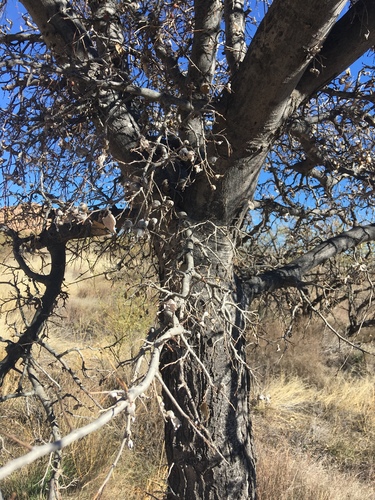
This species typically grows as a small, shrubby tree ranging from 3 to 15 meters in height, featuring a highly distinctive grey trunk with corky, wart-like ridges that become more pronounced with age. Its thick, leathery, and ovate leaves have a rough, sandpaper-like upper texture and a pale underside marked by a raised, net-like web of veins. During late summer and autumn, the tree is adorned with small, spherical, single-seeded drupes that ripen from green to a dark orange or reddish-purple color.
Category
PlantsRarity
Common
Danger
1/5 · Very low
Snaps
Be the first to snap!
Indigenous peoples of the Southwest, such as the Navajo and Apache, traditionally ate the sweet drupes fresh or ground them with dried meat to make highly portable survival cakes.
Its heavy, tough wood was historically used by Native Americans to craft durable items such as tool handles, bows, and firewood.
The common name 'hackberry' is believed to be an altered form of 'hagberry', a historic English name for the wild bird cherry.
Unlike most trees which smooth out as they age, the Netleaf Hackberry's corky bark ridges become more dramatic and deeply furrowed the older it gets.
Possesses deep, aggressive taproots and thick, leathery leaves designed to minimize water loss, allowing it to survive in arid environments.
The unique, protruding corky ridges on its bark act as an insulation layer, protecting the delicate inner cambium from temperature extremes and wildfires.
Its extensive root network binds loose, gravelly canyon soils, effectively stabilizing banks and slopes against flash floods.
As a photosynthetic plant, the Netleaf Hackberry synthesizes its own sugars using sunlight, water, carbon dioxide, and essential minerals absorbed from the soil.

Bombycilla cedrorum
Consumes the sweet, fleshy autumn drupes and disperses the seeds across the landscape.
Nymphalis antiopa
The leaves of the Netleaf Hackberry serve as a primary host plant for this butterfly's caterpillars.
Turdus migratorius
Feeds on the nutritious berries during fall and winter when other food sources are scarce.
No trait badges are assigned for this object yet.
No aliases listed yet.
Collections for this object will appear here as more themes are added.
Danger
1/5 · Very low
No special safety notes yet.
Compare how the fruit is clustered, the leaves and their arrangement, the stems and any thorns. Red, blue and black fruits grow on lots of unrelated plants, and the same color can show up on both edible and poisonous species. Berry Identifier: upload a photo and compare the visible details.
300-1500 cm
100-200 years
As a photosynthetic plant, the Netleaf Hackberry synthesizes its own sugars using sunlight, water, carbon dioxide, and essential minerals absorbed from the soil.
Found in dry canyons, rocky slopes, grasslands, and along desert riparian zones across western North America.
Photosynthesis
Zoom in to split clusters and explore where this object has been snapped.
Recent snaps will appear here as new observations are added.
Take the discovery with you
Snap it with Snappit to identify it, learn what makes it special, and add the discovery to your collection.