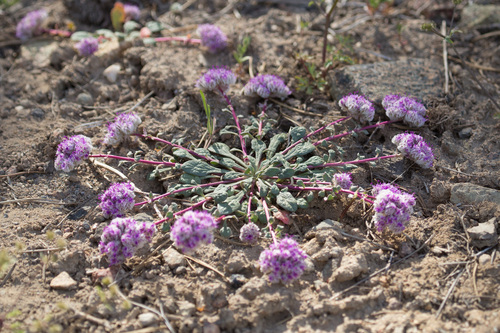


One-Seeded Pussypaws
calyptridium monospermum
Calyptridium monospermum, commonly known as One-Seeded Pussypaws, is a fascinating annual herb native to western North America. Despite its diminutive size, this plant plays an important role in its dry, often harsh ecosystems. It is part of the Montiaceae family, known for its resilience and adaptability. Its common name "pussypaws" refers to the soft, fuzzy appearance of its flower clusters, while "one-seeded" points to its distinct reproductive strategy, producing a single, efficient seed per fruit. This small plant is a testament to nature's ability to thrive in challenging conditions, often being one of the first species to colonize disturbed ground.
Habitat: This resilient annual thrives in dry, open habitats such as rocky slopes, chaparral, open pine woodlands, sandy flats, and disturbed gravelly or clay soils.
The One-Seeded Pussypaws is a low-growing annual, typically reaching heights of only 2 to 15 centimeters. It features a basal rosette of spatulate to oblanceolate leaves, often somewhat succulent, with the entire plant sometimes taking on a reddish tinge, especially in drier conditions. Its inconspicuous flowers are clustered at the stem tips, emerging from dense, woolly sepals that give them their characteristic "pussypaws" look. The tiny petals are usually white to pale pink or purplish, adding a delicate contrast to the fuzzy clusters.
Category
PlantsRarity
Common
Danger
1/5 · Very low
Snaps
1
Despite its delicate appearance, One-Seeded Pussypaws is a tough pioneer plant, often being among the first to grow in areas disturbed by fire or erosion, helping to stabilize the soil.
Its taxonomic classification has shifted; it was formerly placed in the Portulacaceae family (purslane family) but is now recognized within the Montiaceae family.
The common name 'pussypaws' is shared by several species within the Calyptridium and other related genera, referring to the soft, often woolly appearance of their flower clusters.
The genus name 'Calyptridium' comes from Greek, meaning 'a little cover,' referring to the small, cap-like structure that covers the developing fruit.
The plant's slightly succulent leaves and annual life cycle allow it to efficiently utilize available moisture and complete its life cycle before prolonged dry spells in arid environments.
Each fruit consistently produces a single, viable seed, ensuring reproductive success even with limited resources, a trait reflected in its scientific name.
One-Seeded Pussypaws often colonizes disturbed or barren ground, helping to stabilize soil and initiate ecological succession in harsh, exposed environments.
As an autotrophic plant, Calyptridium monospermum produces its own food through photosynthesis, converting sunlight, water, and carbon dioxide into sugars for energy and growth. It absorbs essential mineral nutrients from the soil.
Andrena spp.
Pollinates flowers during bloom time
Schistocerca spp.
Herbivore consuming plant foliage
Pogonomyrmex spp.
Aids in seed dispersal, potentially attracted to elaiosomes or seed size

Bromus tectorum
Competes for soil moisture and nutrients in dry, open habitats
No trait badges are assigned for this object yet.
No aliases listed yet.
Collections for this object will appear here as more themes are added.
Danger
1/5 · Very low
No special safety notes yet.
The easiest way to identify One-Seeded Pussypaws is to use the Snappit nature identifier app.
2-15 cm
0.001-0.01 kg
0-1 years
As an autotrophic plant, Calyptridium monospermum produces its own food through photosynthesis, converting sunlight, water, and carbon dioxide into sugars for energy and growth. It absorbs essential mineral nutrients from the soil.
This resilient annual thrives in dry, open habitats such as rocky slopes, chaparral, open pine woodlands, sandy flats, and disturbed gravelly or clay soils.
Photosynthesis
100-1000
Zoom in to split clusters and explore where this object has been snapped.
Take the discovery with you
Snap it with Snappit to identify it, learn what makes it special, and add the discovery to your collection.












.jpg&width=800)



_001.jpg&width=800)




