.jpg&width=800)





Ornate Checkered Beetle
Trichodes ornatus
The Ornate Checkered Beetle is a colorful little bug with a checkered pattern on its back. It loves to crawl around in gardens and fields, helping to keep plants healthy by eating pests.
Habitat: Grasslands
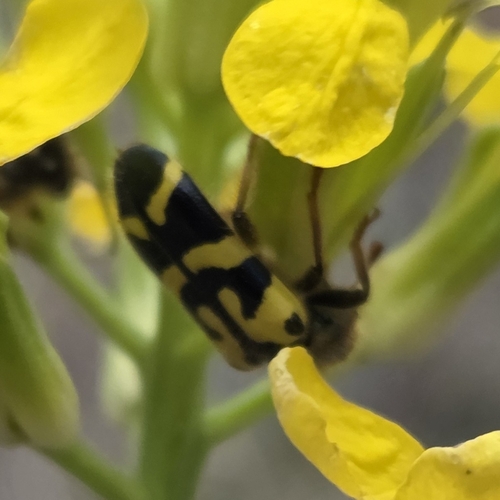
The Ornate Checkered Beetle is a striking insect with a black head and thorax. Its hardened wing covers are a vibrant yellow-orange, marked with bold black bands and spots that create a distinctive checkered appearance.
Category
InsectsRarity
Common
Danger
1/5 · Very low
Snaps
13
Adult beetles visit flowers, but their babies are fierce hunters.
Many bugs try to copy their bright 'stay away' colors!
Their larvae can live for over a year before becoming adult beetles!
They are found only in the western parts of North America.
Ornate Checkered Beetles have bright yellow-orange and black patterns that help warn predators that they might taste bad or be toxic.
Ornate Checkered Beetles can fly with surprising speed because their strong wings allow them to quickly move between flowers or escape danger.
Adults drink nectar, but larvae are tiny hunters that eat other insect babies!
Age differences: Adults feed on pollen and nectar, while the larvae are predatory, hunting other insect larvae in their nests.
Dendroctonus ponderosae
Larvae prey on their larvae
.jpg&width=800)
Megachile rotundata
Larvae prey on their larvae

Sialia mexicana
Adults can be prey for birds
Achillea millefolium
Adults feed on pollen and nectar
Colorful describes organisms or objects displaying a wide range of bright and distinct colors.
Grassland habitats are terrestrial biomes dominated by grasses and herbaceous plants, supporting a variety of grazing animals.
This trait identifies organisms whose diet primarily consists of insects and other small invertebrates.
Describes plants that are particularly attractive and beneficial to a wide range of pollinating organisms.

Diurnal animals are primarily active during daylight hours, typically resting or sleeping at night.

Describes a species whose presence and role have a disproportionately large effect on its environment.

This trait identifies organisms that exhibit exceptional swiftness in movement for hunting, escape, or travel.

Describes organisms that transfer pollen, enabling the fertilization and reproduction of plants.
No aliases listed yet.
Danger
1/5 · Very low
These beetles are harmless, but it's best to watch them from a distance.
The easiest way to identify Ornate Checkered Beetle is to use the Snappit nature identifier app.
15-25 mm
8-15 mm
21-28 days
10 km/h
Adults drink nectar, but larvae are tiny hunters that eat other insect babies!
Grasslands
6
Zoom in to split clusters and explore where this object has been snapped.
May 24, 2026
Bryce Canyon Lodge Historic DistrictPhoto attribution
(c) Jack Byrley, some rights reserved (CC BY)
License: CC BY 4.0 ↗
Image may be shown cropped inside the card frame.

Utah, US
You might spot Common Golden-Mantled Ground Squirrel and Steller's Jay.
View guide →

Utah, US
You might spot Common Golden-Mantled Ground Squirrel and Steller's Jay.
View guide →

Colorado, US
You might spot Elk, Mule Deer, and Black-Billed Magpie.
View guide →

Washington, US
You might spot Tiger, Walrus, and Polar Bear.
View guide →

Nevada, US
You might spot Creosote Bush, Brittlebush, and Beavertail Pricklypear.
View guide →

New Mexico, US
You might spot Black-Billed Magpie and Gunnison's Prairie Dog.
View guide →
Take the discovery with you
Snap it with Snappit to identify it, learn what makes it special, and add the discovery to your collection.







.jpg&width=800)


