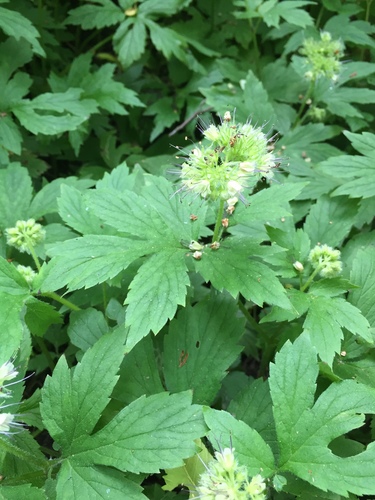


Pacific Waterleaf
hydrophyllum tenuipes
Pacific Waterleaf (Hydrophyllum tenuipes) is a lush, shade-loving perennial herb native to the moist, deciduous forests of the Pacific Northwest. Characterized by its large, deeply lobed leaves and delicate clusters of bell-shaped flowers, this plant serves as a vital component of the forest understory. It thrives in rich, damp soils, often spreading via underground rhizomes to form extensive, vibrant green carpets that stabilize the forest floor and provide shelter for various microfauna. During spring and early summer, its distinctive flowers emerge with prominent, thread-like stamens that give the blooms a fuzzy appearance. Historically used by Indigenous peoples as a food source, the tender young shoots and roots were cooked and consumed.
Habitat: Found in moist, shaded forests, damp woodlands, and riparian zones, typically in nutrient-rich soils at low to middle elevations.
This species features large, alternate leaves that are deeply divided into 7 to 9 sharply-toothed, palmately lobed segments with a rough, hairy texture. The plant grows to heights between 20 and 80 cm, forming dense mounds of soft foliage. Its flowers are clustered in coiled, cyme-like inflorescences and are usually greenish-white, lavender, or cream-colored. Each bell-shaped flower is about 5 to 7 mm long, notably characterized by long, protruding stamens that extend far past the petals, creating a delicate, whiskered look.
Category
PlantsRarity
Common
Danger
1/5 · Very low
Snaps
2
Indigenous peoples of the Pacific Northwest historically cooked the sweet, fleshy roots of this plant as a nutritious food source.
Its fuzzy-looking flowers are highly attractive to native long-tongued bees, making it an excellent addition to shade-friendly pollinator gardens.
The genus name 'Hydrophyllum' translates directly to 'water-leaf,' describing the watery appearance or saturated sap found in the leaves.
Utilizes creeping underground rhizomes to rapidly colonize forest understories and secure soil on sloped terrain.
Features exceptionally long stamens that brush pollen onto visiting bumblebees and flies with maximum efficiency.
Thrives in heavily water-saturated soils, utilizing specialized root structures to resist anaerobic stress.
As a photosynthetic plant, Pacific Waterleaf produces its own organic nutrients using sunlight, water, carbon dioxide, and essential soil minerals.

Bombus vosnesenskii
Visits the flowers for nectar and pollen, acting as a primary pollinator.

Odocoileus hemionus
Forages on the tender spring foliage during early growth phases.
Ariolimax columbianus
Consumes the low-lying, moist leaves in shaded understory habitats.
No trait badges are assigned for this object yet.
No aliases listed yet.
Collections for this object will appear here as more themes are added.
Danger
1/5 · Very low
No special safety notes yet.
The easiest way to identify Pacific Waterleaf is to use the Snappit nature identifier app.
20+ cm
3+ years
As a photosynthetic plant, Pacific Waterleaf produces its own organic nutrients using sunlight, water, carbon dioxide, and essential soil minerals.
Found in moist, shaded forests, damp woodlands, and riparian zones, typically in nutrient-rich soils at low to middle elevations.
Zoom in to split clusters and explore where this object has been snapped.

Oregon, US
You might spot Oregon Oak, Pacific Poison Oak, and American Bullfrog.
View guide →

California, US
You might spot Pipevine Swallowtail and Western Fence Lizard.
View guide →

Washington, US
You might spot Broad-Leaved Stonecrop and Western Sword Fern.
View guide →

Oregon, US
You might spot Green Alkanet, Western Sword Fern, and Pacific Banana Slug.
View guide →

Oregon, US
You might spot Pacific Trillium, Giant White Fawn Lily, and Candy Flower.
View guide →
Take the discovery with you
Snap it with Snappit to identify it, learn what makes it special, and add the discovery to your collection.











.jpg&width=800)



_001.jpg&width=800)




